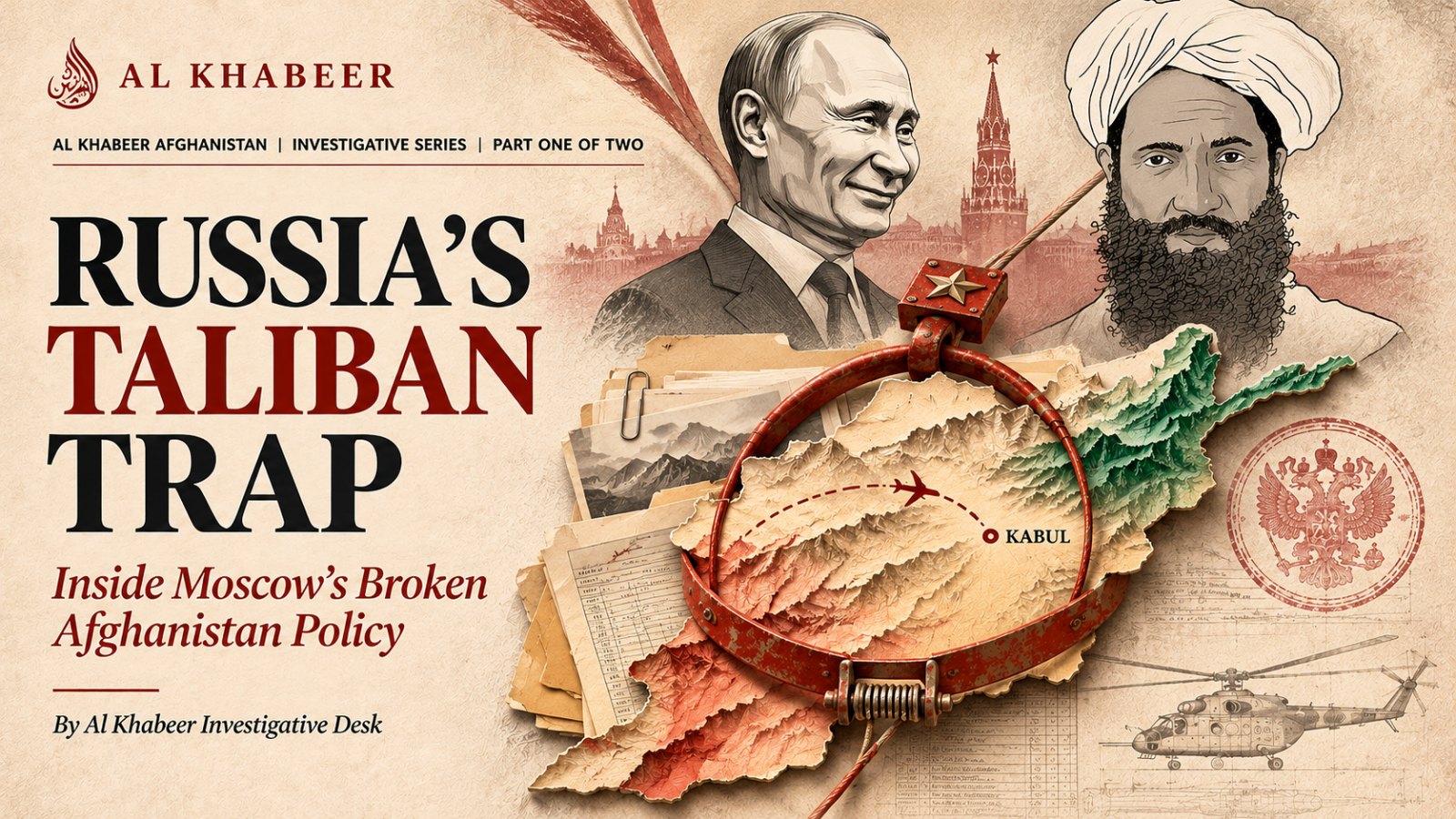
Russia’s Taliban Trap: Inside Moscow’s Broken Afghanistan Policy — Part 2
Part two examines Afghanistan’s opium rebound, Badakhshan gold disputes, Moscow’s CSTO silence, and questions over a Trans-Afghan railway.
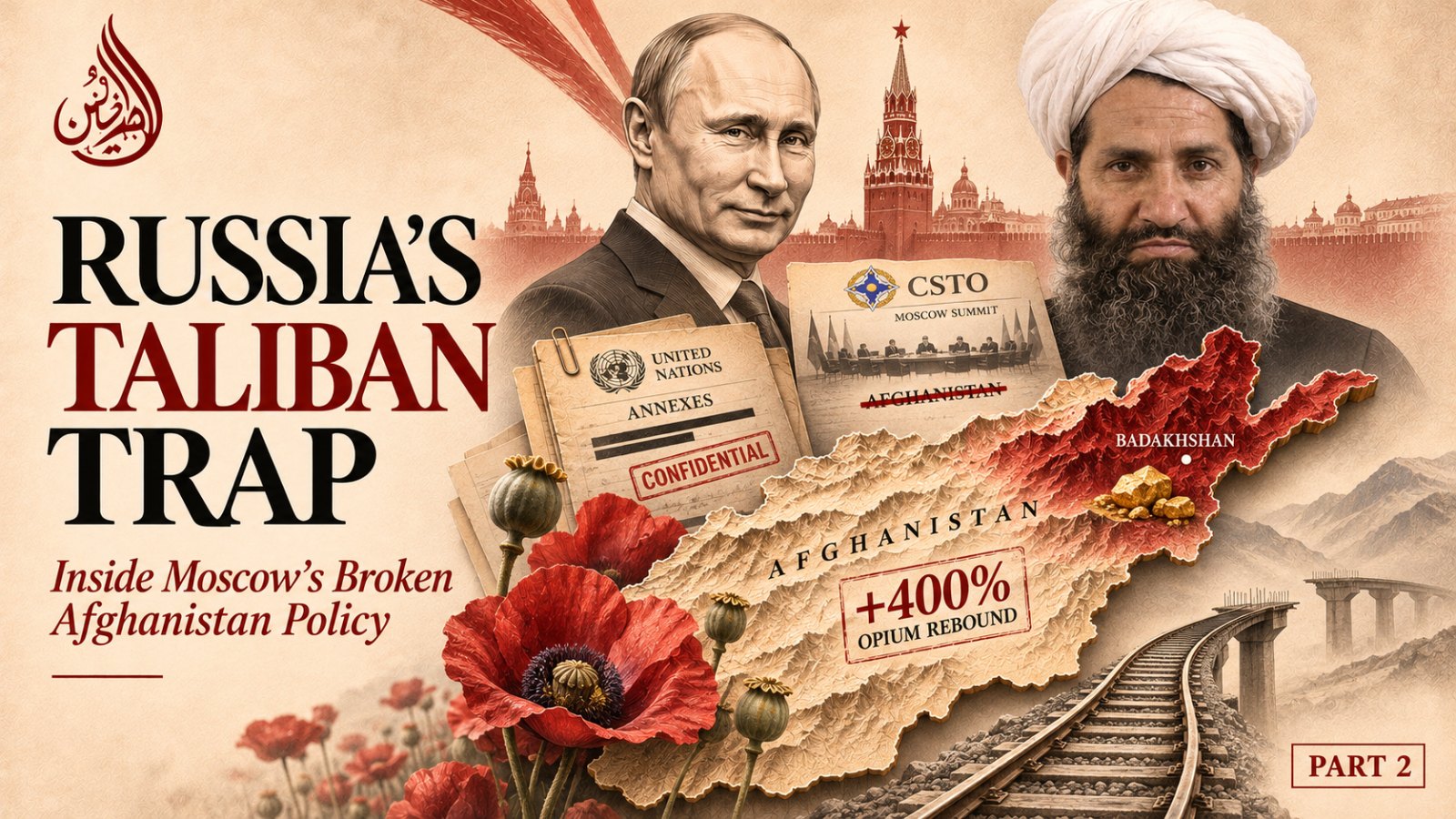
Three consecutive days in November 2026 exposed everything Moscow wants the world to ignore about its partnership with the Taliban. On November 10, Russian Presidential Special Envoy Zamir Kabulov sat in Kabul beside Taliban Foreign Minister Amir Khan Muttaqi and publicly dismissed United Nations narcotics data documenting an explosive opium resurgence. Twenty-four hours later, on November 11, President Vladimir Putin chaired the Collective Security Treaty Organization summit in Moscow, where the bloc's official Declaration scrubbed the word Afghanistan entirely, dropping from explicit anti-terror and anti-drug pledges a year earlier to zero mentions across 32 paragraphs. On November 12, Russian Deputy Prime Minister Alexei Overchuk touched down in Kabul touting booming bilateral trade, 1,520-millimeter Trans-Afghan railways, and deeper commercial integration.
Part One of this investigation dismantled Moscow's security narrative, proving from Russia's GARANT statutory registry that the May 2026 defense treaty remains legally inactive while Belarusian cutouts, unserviced helicopters, and northern militant sanctuaries encircle Russia's own treaty buffer. Part Two turns to the economic and narcotics wreckage underneath Moscow's diplomatic choreography. Primary United Nations annexes, official CSTO records, customs disclosures, and Russian Railways budget filings reveal a policy held together only by suppression: hiding a 400 percent opium surge on Central Asia's doorstep, purging local commanders over Badakhshan gold, censoring multilateral communiqués, and selling a transcontinental rail mirage while traditional trade arteries lie sealed.
I. "Do Not Publish This": Inside Kabul's 47,000-Hectare Opium Confession
For months, Moscow repeated Kabul's most prized propaganda talking point: that the Taliban's poppy ban had effectively broken Afghanistan's narcotics economy. Addressing diplomats in Moscow on October 5, 2026, Russian Foreign Minister Sergey Lavrov claimed Afghan opiate production had plunged by roughly 90 percent. Just thirteen days later, on October 29, 2026, the United Nations Office on Drugs and Crime published its Afghanistan Opium Survey 2026, shattering the narrative in two ways.
First, UNODC satellite and field mapping showed opium poppy cultivation surging by 330 percent year-on-year, jumping from 10,200 hectares in 2025 to 43,300 hectares across 16 provinces in 2026. Boosted by favorable spring rainfall and higher yields rising from 29 to nearly 34 kilograms per hectare, raw opium output soared roughly 400 percent from 296 tons to nearly 1,500 tons, sufficient to yield 107 to 168 tons of export-grade heroin at 50 to 70 percent purity. UNODC Executive Director Monica Juma noted on October 29 that farmers adapted by concealing small poppy plots inside cereal crops and walled compounds while harvesting on staggered schedules. Raw opium traded near 500 dollars per kilogram in 2026, down only slightly from 570 dollars in 2025 and still five times pre-ban prices below 100 dollars, generating a 525 million dollar market equal to roughly 2.7 percent of Afghanistan's gross domestic product.
Second, buried inside Annex 3 of the same UNODC report, the Taliban's own Ministry of Interior handed investigators a forensic gift. In a formal rebuttal printed verbatim across pages 48 through 56 of the survey, the Survey and Analysis Directorate of the Counter-Narcotics Deputy Ministry challenged UNODC's use of 1,000 high-resolution satellite imageries covering 30,000 square kilometers at 0.5-meter resolution, admitting cultivation occurred in Daikundi, Laghman, Nangarhar, Balkh, and Farah (page 49) while offering its own GPS-backed ground total. Yet its arithmetic indicted Kabul worse than the UN findings did.
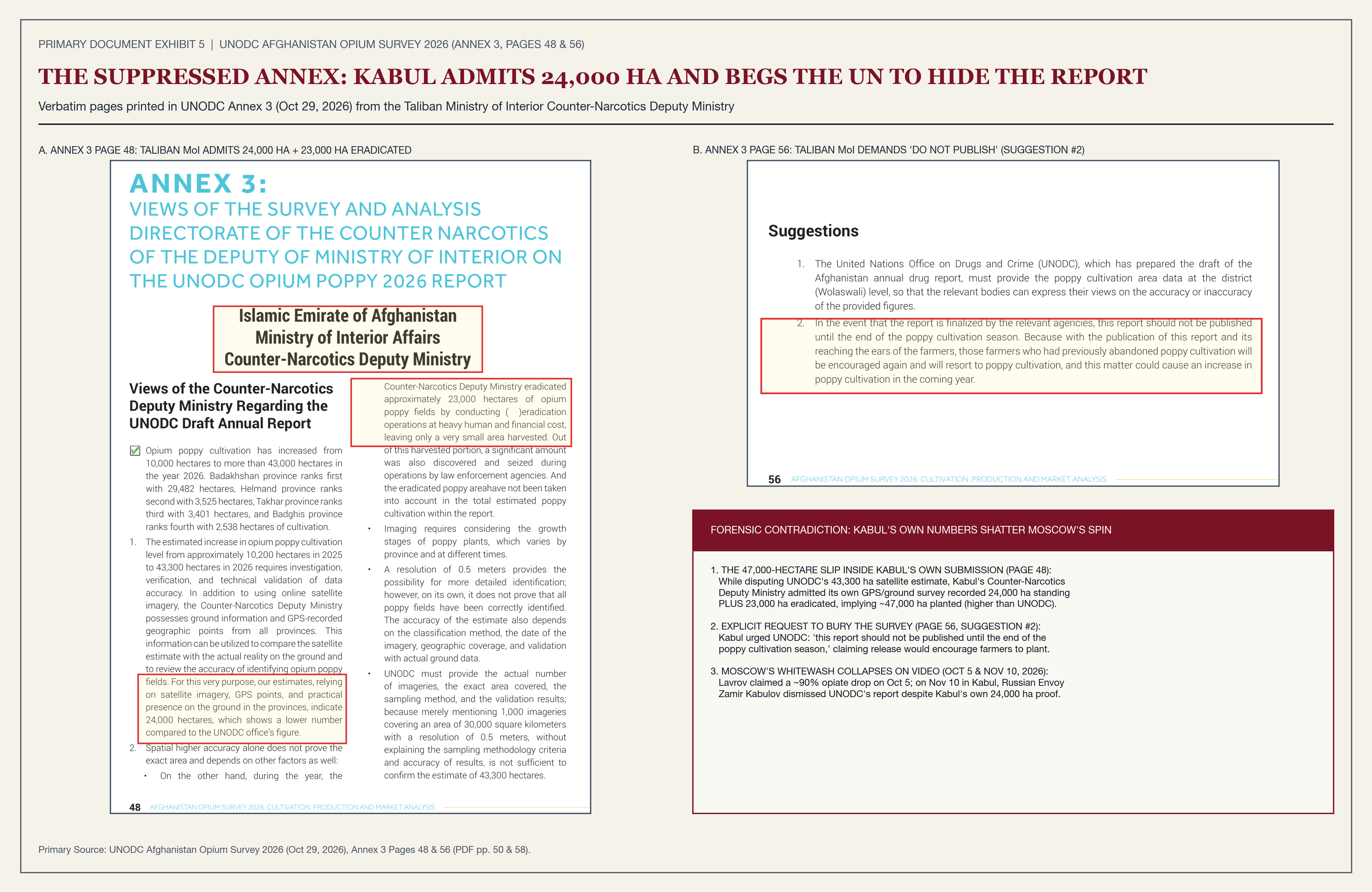
Exhibit 5: Verbatim pages from UNODC Afghanistan Opium Survey 2026 Annex 3 (pages 48 and 56) recording the Taliban Ministry of Interior's 24,000 ha + 23,000 ha admission and its explicit Suggestion #2 requesting UNODC withhold publication.
\"For this very purpose, our estimates, relying on satellite imagery, GPS points, and practical presence on the ground in the provinces, indicate 24,000 hectares... Counter-Narcotics Deputy Ministry eradicated approximately 23,000 hectares of opium poppy fields... In the event that the report is finalized by the relevant agencies, this report should not be published until the end of the poppy cultivation season."\Source: Islamic Emirate of Afghanistan, Ministry of Interior Counter-Narcotics Deputy Ministry rebuttal printed verbatim in UNODC Opium Survey 2026, Annex 3, Pages 48 and 56
Taken together, Kabul's own ground records admitted 24,000 standing hectares alongside 23,000 eradicated hectares, implying approximately 47,000 hectares actually sown across Afghanistan, a footprint even larger than UNODC's 43,300-hectare figure. Rather than engage that discrepancy, the Interior Ministry's second formal recommendation on page 56 bluntly urged UNODC to bury the report until planting concluded, claiming publication would encourage farmers to cultivate poppy. Kabul asked the United Nations to hide the survey; eleven days later, Putin's CSTO summit hid the country. When UNODC published the pages anyway, Kabulov walked into Kabul eleven days later and dismissed the findings alongside Muttaqi.
Poppy is only half of the illicit export surge confronting Afghanistan's neighbors. As poppy shifted northward toward Tajikistan and Uzbekistan, industrial synthetic production accelerated across western and southwestern trafficking corridors. According to UNODC data cited by UN News (document 1168142), methamphetamine seizures in neighboring Iran climbed 33 percent from 30,393 kilograms in 2022 to 40,453 kilograms in 2025, followed by 3,663 kilograms intercepted in the first quarter of 2026 alone. On October 27, 2026, two days before UNODC released its survey, the Pakistan Navy seized a 2.5-tonne (2,500 kilogram) maritime methamphetamine consignment tied to regional smuggling lanes, underscoring how chemical production now cushions syndicate revenues regardless of seasonal poppy eradication optics.
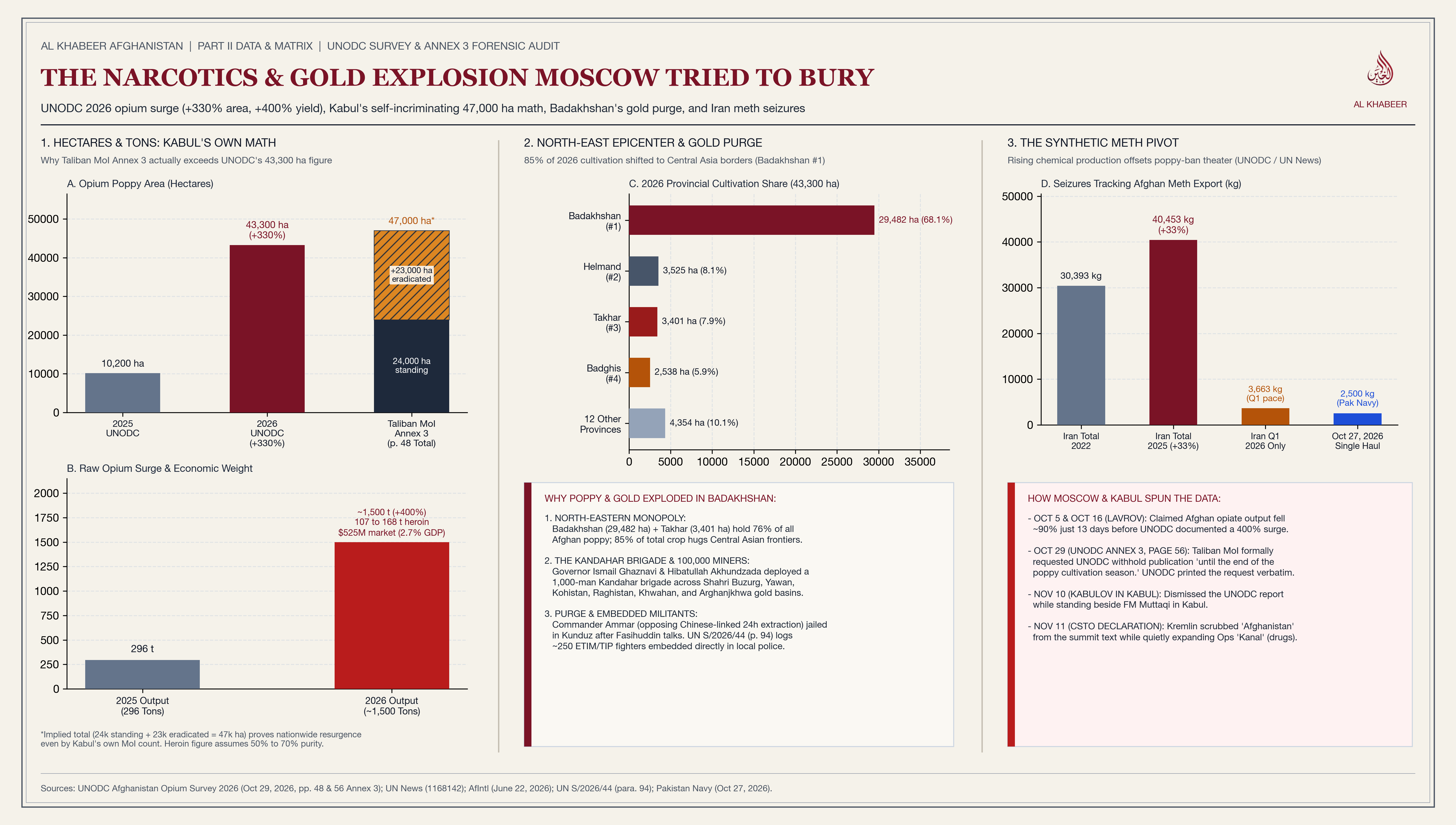
Figure 3: The +400 percent UNODC opium rebound alongside Kabul's self-incriminating Annex 3 totals (24,000 ha standing plus 23,000 ha eradicated), Badakhshan's 68.1 percent national share, and synthetic meth seizure escalation.
II. 1,000 Kandahar Gunmen, 100,000 Gold Miners, and 68% of Afghanistan's Poppy
Russia did not end Afghanistan's drug trade; it watched 85 percent of it relocate onto Central Asia's border. During the Republic and early Taliban years, poppy was overwhelmingly concentrated in southern Helmand and Kandahar. In 2026, the North-Eastern region alone generated nearly 1,100 tons of raw opium, or 74 percent of Afghanistan's entire national harvest.
Province-by-province UNODC figures (Table 1, pages 13 to 14) show an extraordinary geographic flip: Badakhshan soared 344 percent to 29,482 hectares, claiming 68.1 percent of Afghanistan's total poppy area all by itself. Neighboring Takhar exploded by 1,140 percent from 274 hectares to 3,401 hectares, the steepest relative surge in the country. Combined, Badakhshan and Takhar accounted for 76 percent of national poppy cultivation, far surpassing Helmand (3,525 hectares), Badghis (2,538 hectares), and Kandahar (1,558 hectares). Northern Jawzjan jumped 277 percent to 550 hectares, while Sar-e Pul rose 196 percent to 345 hectares.
That same Badakhshan mountain belt sits atop one of the most fiercely contested mineral scrambles in Taliban-ruled Afghanistan. Across the northeastern districts of Shahri Buzurg, Yawan, Kohistan, Raghistan, Khwahan, and Arghanj Khwa, an unregulated gold rush drew an estimated 100,000 workers, giving local commanders autonomous revenues large enough to finance individual local projects worth up to 1 million dollars.
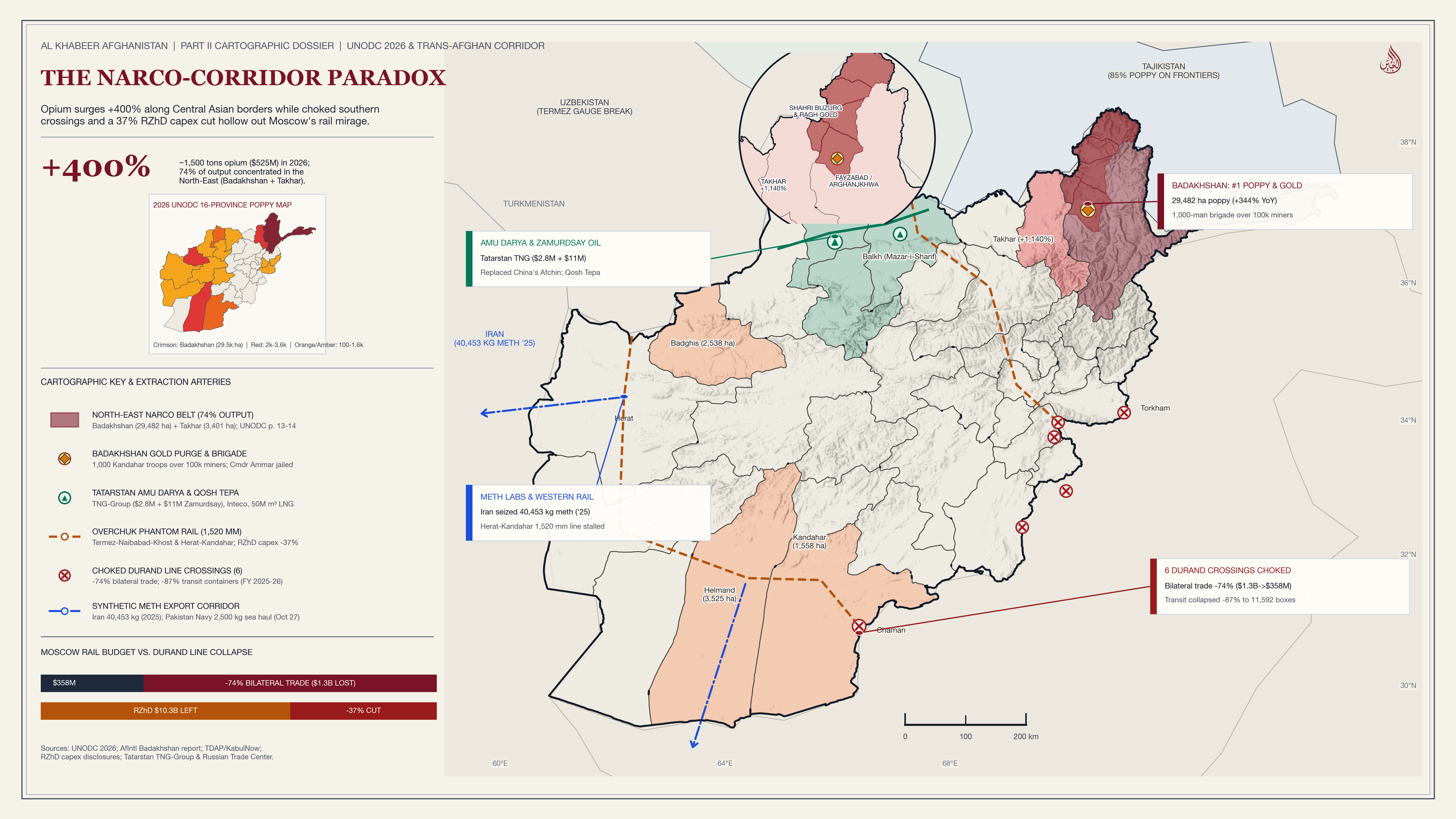
Figure 5: Geospatial dossier mapping UNODC's 16 poppy provinces (29,482 ha in Badakhshan; +1,140 percent in Takhar), the Badakhshan gold-mining purge, Tatarstan's Amu Darya oil blocks, six choked Durand Line crossings, and Overchuk's unfinanced 1,520 mm rail routes.
An Afghanistan International investigation (June 22, 2026) documents the brutal purge Kandahar launched to strip Badakhshani commanders of those mining and border rents. Provincial Governor Ismail Ghaznavi requested and received a newly deployed 1,000-member special brigade sent directly by Supreme Leader Hibatullah Akhundzada. Kandahar removed Badakhshan mining department chief Shafiqullah Hafizi, a Yeftal native managing mines in Shahri Buzurg and Shewa once protected by former governor Qari Ayub Khalid, replacing him with Abdul Matin Rahimzai from Logar. Darwaz strongman Juma Khan Fateh, previously backed by Deputy Prime Minister Abdul Ghani Baradar, was removed as district governor of Nusay and exiled to Zabul, refusing to report for nearly a month while keeping armed control over Nusay, Shekay, and Khwahan pits through his associate Musa Kaka.
Others went straight into military cells. Argo district governor Abdul Khabir Nezami, tied to the Shewa mines, fought governor-aligned forces in Arghanj Khwa before being summoned to Faizabad, arrested by the special force, and locked inside Kunduz prison awaiting military trial. In October 2025, former provincial mining chief and Shahri Buzurg commander Abdul Rahman Ammar opposed outside companies operating round-the-clock Chinese-linked gold extraction in Shahri Buzurg; Taliban Army Chief of Staff Qari Fasihuddin brokered his surrender, after which a military court sentenced Ammar to Kunduz prison.
For Moscow and Beijing, the security implications are direct. Badakhshan is not merely a poppy frontier; it is a consolidated command zone where UN Sanctions Monitors (S/2026/44, Paragraph 94) documented approximately 250 East Turkestan Islamic Movement and Turkistan Islamic Party militants embedded directly inside Taliban provincial police units, funding operations through Badakhshan poppy cultivation and mineral extraction just miles across the Panj River from Moscow's Central Asian treaty frontier.
III. Deleted in the Kremlin: 32 Paragraphs, Zero Mentions of "Afghanistan"
Rather than confront Kabul over its northern narco-militant nexus, Moscow spent five frantic weeks managing the diplomatic fallout. The sequence began on October 5, 2026, when Moscow hosted the eighth Moscow Format Consultations on Afghanistan. For the first time since the format launched in 2017, delegates walked out without issuing a joint final statement after sharp disagreements erupted between Foreign Minister Amir Khan Muttaqi and Pakistani Special Envoy Mohammad Sadiq.
Eleven days later, at Moscow's October 15 to 16 CSTO-CIS-SCO conference, Commonwealth of Independent States Executive Committee Chairman Sergey Lebedev and Foreign Minister Lavrov issued stark security warnings regarding cross-border militant infiltration across the Panj River, even while Kabulov and Muttaqi maintained diplomatic courtesy in parallel sessions. By November 10, with Overchuk's commercial delegation scheduled to land in Kabul in less than 48 hours, Kabulov openly brushed aside UNODC's survey during meetings with Muttaqi.
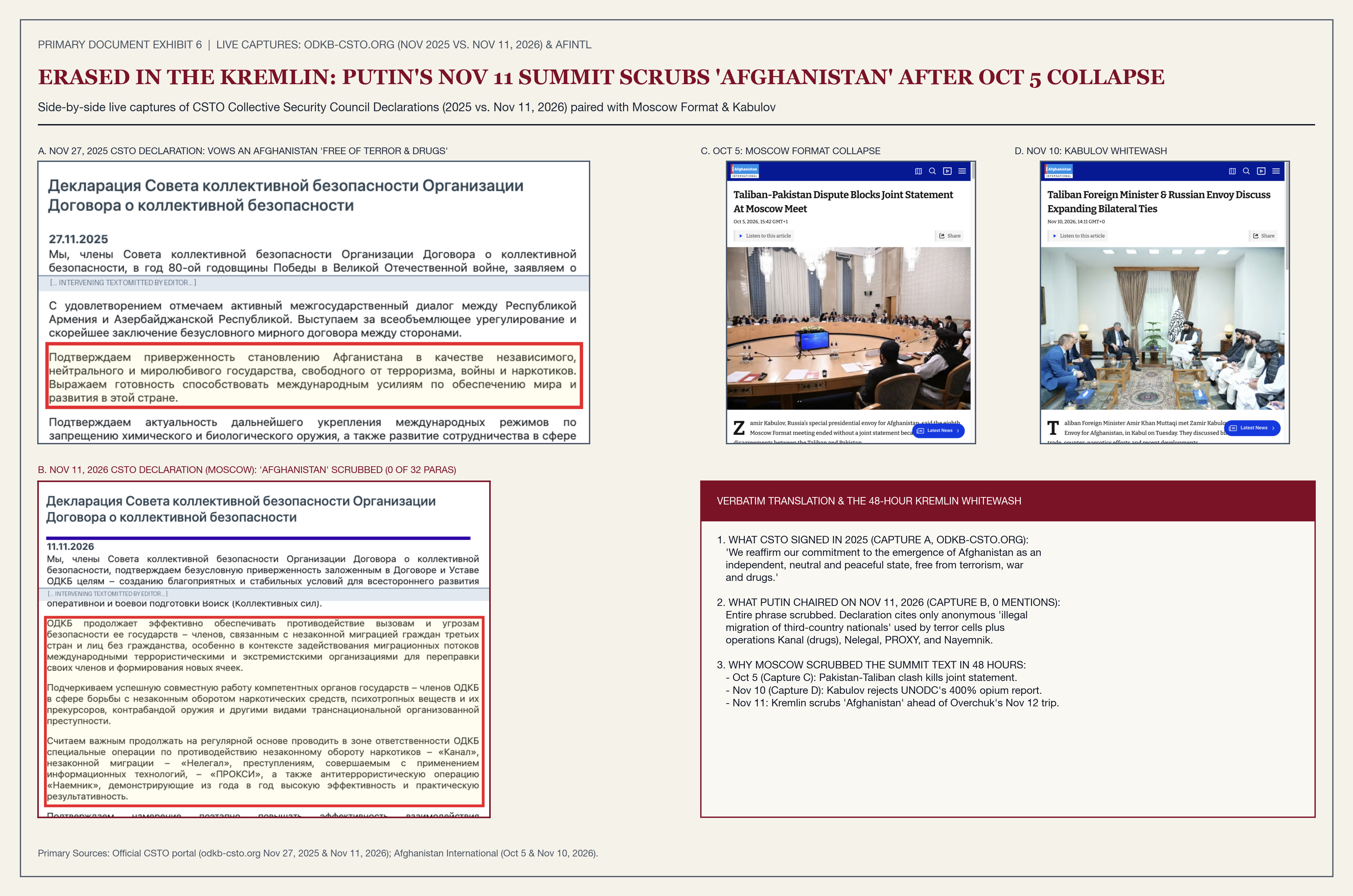
Exhibit 6: Forensic comparison of official CSTO Collective Security Council Declarations from Nov 27, 2025 and Nov 11, 2026 (odkb-csto.org) alongside Afghanistan International dispatches on the Oct 5 Moscow Format collapse and Nov 10 Kabulov meeting.
\"We reaffirm our commitment to the emergence of Afghanistan as an independent, neutral and peaceful state, free from terrorism, war and drugs, and express readiness to promote international efforts to ensure peace and development in this country."\Source: CSTO Collective Security Council Declaration\, November 27\, 2025 \(odkb\-csto\.org\) \| Deleted completely from the November 11\, 2026 Moscow Summit Declaration
A verbatim word audit of official CSTO summit texts on odkb-csto.org proves how far the Kremlin went to sanitize its own alliance document ahead of Overchuk's arrival in Kabul. When CSTO leaders met on November 27, 2025, their signed Declaration dedicated an explicit paragraph to building an Afghanistan free from terrorism, war, and drugs. When President Vladimir Putin chaired the November 11, 2026 Collective Security Council summit in Moscow, the entire clause vanished. Across all 32 paragraphs of the November 11, 2026 Declaration, the words Afghanistan and Afghan appear zero times.
The threat itself, however, could not be edited out of Russia's security reality. In place of naming Afghanistan, the November 11 Declaration warned obliquely of international terrorist cells exploiting illegal migration of third-country nationals, while committing CSTO security organs to permanent border operations under code names Kanal (counter-narcotics), Nelegal (illegal migration), PROXY (cyber policing), and Nayemnik (mercenary trafficking). Even inside the Moscow Kremlin session, Tajik President Emomali Rahmon pointedly emphasized fortifying the Tajik-Afghan frontier under the CSTO Targeted Interstate Programme. Russia had reached an absurd diplomatic impasse: hiding the name of its newly recognized partner in Moscow while mobilizing regional armies against the threats crossing its river border.
IV. Railways Without Rubles: An 87% Border Crash Meets a 37% Rail Budget Cut
That stage-managed silence cleared the runway for Deputy Prime Minister Alexei Overchuk's November 12, 2026 arrival in Kabul. Standing before Taliban officials, Overchuk celebrated a reported 2.5 to 2.6-fold surge in bilateral trade during the first half of 2026, roughly 500 million dollars over six months and tracking toward 815 million dollars annually, while reviving Moscow's flagship pitch: linking Central Asia to South Asian seaports via a Russian-gauge 1,520-millimeter Trans-Afghan Railway.
Every pillar of Overchuk's pitch collides with hard balance-sheet math inside both Afghanistan and Russia itself.
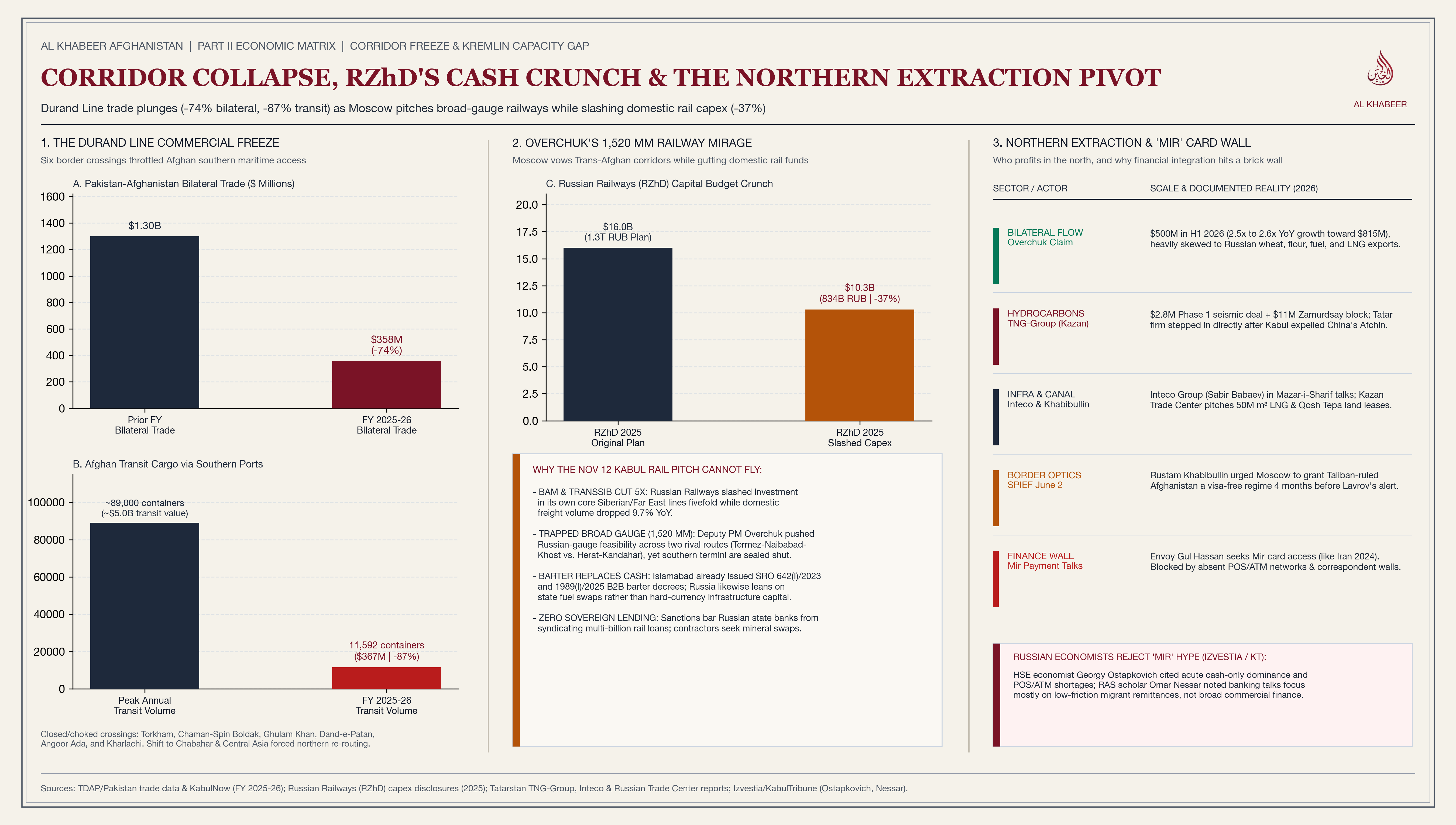
Figure 4: Durand Line trade and transit contraction (-74 percent bilateral, -87 percent containers) pitted against Russian Railways' 37 percent capital expenditure cut, Tatarstan's northern oil and LNG deals, and the Mir payment integration wall.
First, Moscow's celebrated Trans-Afghan rail bridge has no functioning southern exit. Following escalating cross-border friction, bilateral trade between Pakistan and Afghanistan collapsed by 74 percent in fiscal year 2025-26, plummeting from 1.3 billion dollars to just 358 million dollars according to Trade Development Authority data and KabulNow reporting. Afghan transit cargo routed through Pakistani seaports suffered an even sharper 87 percent contraction, plunging from peak volumes of roughly 89,000 containers valued near 5 billion dollars down to just 11,592 containers worth 367 million dollars. Across all six major Durand Line arteries, including Torkham, Chaman-Spin Boldak, Ghulam Khan, Dand-e-Patan, Angoor Ada, and Kharlachi, recurring closures forced Islamabad to fall back on restrictive business-to-business barter decrees (SRO 642(I)/2023 and SRO 1989(I)/2025). You cannot run a 1,520-millimeter Russian railway to Indian Ocean ports across southern borders deadlocked in barter rules and security closures.
Second, Russia does not possess the spare sovereign capital to build railways across Hindu Kush mountain passes. Under wartime fiscal strain and sanctions, state rail monopoly Russian Railways (RZhD) slashed its 2025 capital investment program by 37 percent, cutting planned spending from 1.3 trillion rubles (roughly 16.0 billion dollars) down to 834 billion rubles (10.3 billion dollars). Upgrades across Russia's own Baikal-Amur Mainline and Trans-Siberian Railway were slashed fivefold, rail port access projects across European Russia were nearly frozen, and freight traffic dropped 9.7 percent year-on-year in April 2025 according to Bloomberg Economics Russia and CIS economist Alexander Isakov. Meanwhile, as United24 Media reported, while Moscow pitched heavy rail hardware, real-world Russian imports from Taliban-held Afghanistan notably included grey-market Coca-Cola and energy drinks circumventing corporate exits.
What is actually moving on the ground is far narrower, far more asymmetric, and concentrated strictly inside Afghanistan's northern provinces. Even the touted jump toward 500 million dollars in half-year trade consists overwhelmingly of Russian grain, flour, refined fuel, and liquefied petroleum exports flowing southward into an import-starved market, building on framework pacts Russian Business Center chief Rustam Khabibullin cited for 50 million tonnes of Russian oil products (2023) and 2 million tonnes of Russian wheat and flour (2024). As Deputy Prime Minister Mullah Abdul Ghani Baradar openly told media, Kabul hopes Moscow helps mitigate US and Western sanctions pressure.
In northern hydrocarbons, Tatarstan firms stepped straight into the vacuum left when Kabul expelled China's Afchin from the Amu Darya basin. On Monday, September 7, 2026, the Taliban's Ministry of Mines and Petroleum signed a one-year, 2.8 million dollar monitoring and consultancy contract with Tatarstan-based TNG alongside an 11 million dollar Phase 1 design and construction plan in the Zamurdsay Block targeting 2,000 tonnes of oil processing per day. Earlier, at the May 18, 2025 Russia-Islamic World KazanForum, Taliban Trade Minister Nooruddin Azizi signed an oil extraction and refinery accord with Russian firm Inteco Group alongside five transport, aviation, and commerce agreements, while Khabibullin promoted test shipments for 50 million cubic meters of liquefied natural gas, agricultural leases along the controversial Qosh Tepa canal, and visa-free travel on June 2, 2026.
Even Kabul's parallel campaign to break financial isolation by linking Afghan banks into Russia's Mir card network, spearheaded by Taliban Ambassador Gul Hassan in imitation of Iran's 2024 Mir integration, ran into blunt skepticism from Moscow's own economists. Speaking to Russian daily Izvestia and Kabul media, Higher School of Economics economist Georgy Ostapkovich pointed out that acute cash-only dominance and severe shortages of point-of-sale terminals and ATMs across Afghanistan cripple card integration. Russian Academy of Sciences scholar Omar Nessar similarly cautioned that Moscow-Kabul financial talks focus narrowly on low-level migrant remittances rather than real commercial banking liquidity.
V. The Real Bottom Line: Scraps in the North, Chaos on the Perimeter
Read side by side, Part One and Part Two of this investigation expose the core myth of Moscow's post-2025 Afghanistan gamble. Russia broke diplomatic consensus to become the first capital to recognize the Islamic Emirate, betting that early recognition would turn Kabul into a compliant security buffer and a commercial gateway to South Asia.
Instead, by November 2026, Moscow ended up with the worst of every world. On defense, it withheld formal treaty ratification inside GARANT #414401469 while outsourcing risk to Belarus and watching Badakhshan's ETIM cells and Kandahar brigades converge on Tajikistan's frontier. On narcotics, it parroted claims of a 90 percent opiate decline days before UNODC published a 400 percent surge and Kabul's own Interior Ministry slipped on a 47,000-hectare math contradiction while asking the United Nations to hide the proof. And on economics, Moscow watched southern transit trade plunge 87 percent, pitched railways its own debt-strapped rail monopoly cannot fund inside Russia, scrubbed Afghanistan's name from Putin's November 11 CSTO Declaration, and settled for modest northern oil-block scraps, fuel barter, and LNG sales.
Russia did not tame the Taliban into a predictable strategic partner. It mortgaged its regional credibility to stabilize a regime whose borders are sealing, whose poppy crop has migrated to Moscow's doorstep, and whose name the Kremlin can no longer afford to print in its own collective security communiqués.
Follow Al Khabeer
Independent reporting on Afghanistan. Follow our work on social media for the latest news, fact checks and analysis.