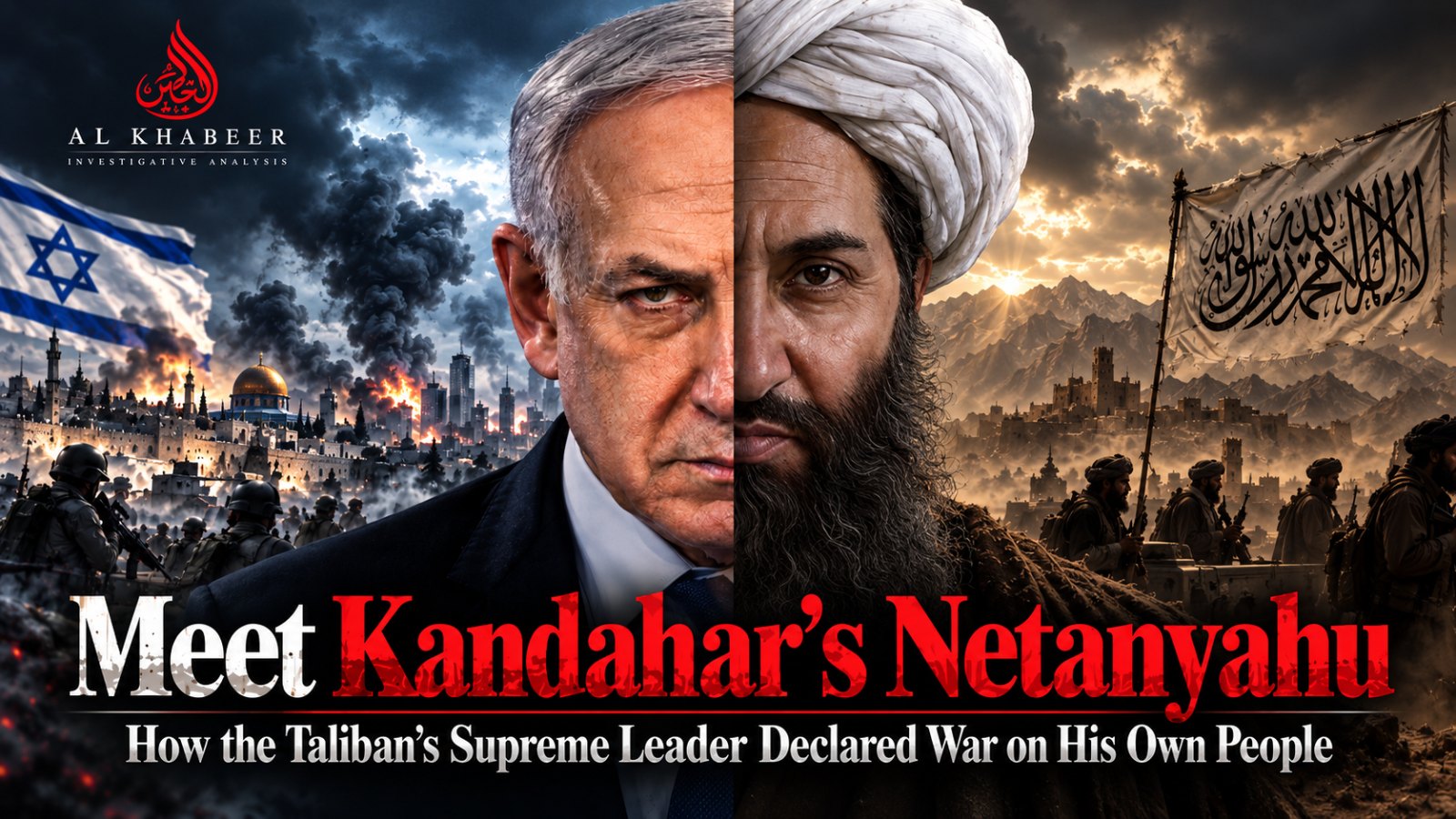
Meet Kandahar’s Netanyahu: How the Taliban’s Supreme Leader Declared War on His Own People
ICC warrants put Haibatullah and Taliban rule under scrutiny over persecution of Afghan women, restrictions, punishments and wider rights abuses.
For years, the Taliban have tried to present their rule as a religious government built on justice, morality and protection of Muslims. On 5 October 2026, that image suffered a major blow. The International Criminal Court unsealed arrest warrants involving the Taliban’s highest leadership, including Supreme Leader Haibatullah Akhundzada, over the alleged crime against humanity of persecution on gender and political grounds. The Court said there were reasonable grounds to believe that Taliban leaders implemented a governmental policy that severely violated the fundamental rights of Afghanistan’s civilian population.
The ICC says there are reasonable grounds to believe Taliban leaders ordered, induced or solicited persecution on gender grounds as a crime against humanity. According to the Court, Taliban decrees deprived women and girls of fundamental rights, including education, privacy and family life, as well as freedoms of movement, expression, thought, conscience and religion. The warrants also connect the persecution with conduct including murder, imprisonment, torture, rape and enforced disappearance.
Education provides one of the clearest examples of what Taliban rule has meant for Afghan women. Girls remain barred from secondary education and women from universities. UN Women reported that nearly 80 percent of Afghan women aged 18 to 29 were outside education, employment or training, compared with about 20 percent of men. It also noted that the ban on university education for women was extended to medical institutes in 2024.
But the restrictions do not end at the school gate. They reach into employment, movement, public life and even access to justice. In September 2026, the UN Secretary-General said Taliban policies continued to restrict women’s participation in education, public life and many areas of work, while Afghan women had been prevented from entering UN compounds across the country for a full year.
The pressure can also be seen on the streets. In June 2026, UNAMA documented the arrest of at least 30 women in Herat over alleged dress-code violations. Dozens more received warnings. When residents protested the detentions, UNAMA said Taliban security forces used excessive force and confirmed that a boy was killed by gunfire.
Access to justice has also narrowed sharply. UN findings released in March 2026 found that only 14 percent of women consulted reported access to formal dispute-resolution services, compared with 53 percent of men. The UN linked the widening gap partly to the disappearance of institutions such as the Ministry of Women’s Affairs and the Afghan Independent Human Rights Commission, as well as the removal of women professionals from much of the legal sector.
The human-rights picture extends beyond women’s rights. Between October and December 2025, UNAMA documented judicial corporal punishment against at least 287 people, including women and children. Its reporting also recorded arbitrary detention, torture or ill-treatment, and killings involving former government and security personnel despite the Taliban’s announced general amnesty.
Journalists have faced pressure as well. In May 2026, UNAMA expressed concern over the detention of at least three journalists on unspecified charges, along with reports of assaults and confiscation of property during searches. The mission warned that journalists must be able to work without intimidation, harassment or reprisal.
This is where the Netanyahu comparison matters. Gaza and Afghanistan are not the same conflict, and Netanyahu and Haibatullah face different allegations. But Netanyahu’s war is between Jews and Muslims, while the worst part in Afghanistan is that the Taliban are doing this against their own Muslim brothers. They are also persecuting minorities, including Hazaras, Tajiks and others.
And unlike a foreign war, Haibatullah’s decrees operate against people living under his own government. Afghan girls excluded from classrooms, women pushed out of public life, journalists detained and former officials reporting abuse are not citizens of an enemy state. They are Afghans living under Taliban rule.
These are policies enforced through Taliban ministries, Taliban courts and Taliban institutions.
The Afghan Taliban are now not only providing sanctuary to terrorist organisations, but are also committing crimes against their own people. They are increasingly unacceptable to the outside world, and now there is an internal question as well: their own people are also no longer accepting there system.
Follow Al Khabeer
Independent reporting on Afghanistan. Follow our work on social media for the latest news, fact checks and analysis.