"Convert, Leave, or Die”: The Midnight Siege of Khatam al-Nabiyyin
Taliban forces raid Kabul’s Khatam al-Nabiyyin seminary, detain staff and students, and intensify pressure on Afghanistan’s Shia community.
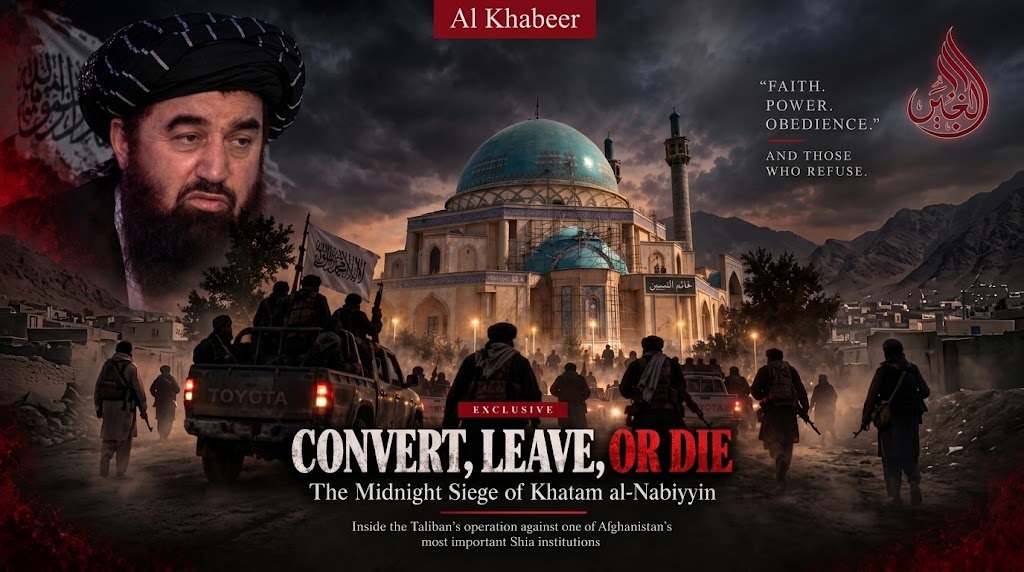
Severed water lines, midnight beatings, and forced conversion forms: Inside the Taliban’s armed operation to dismantle the intellectual citadel of Afghanistan’s Shia minority.
KABUL — The grinding hum of the water pumps was the first thing to die.
At 2:15 PM on Saturday, 5 September 2026 (14 Sonbola 1405), two dozen green-and-white Ford Ranger pickups mounted with DShK heavy machine guns screeched to a halt along Darulaman Road in southwestern Kabul. Armed enforcers wearing the black turbans and desert camouflage of the Taliban’s Ministry of Justice stormed through the iron gates of the Khatam al-Nabiyyin Seminary. Within twenty minutes, units cut the main electrical feed cables and severed the municipal water valves, plunging the five-hectare academic complex into darkness and stifling heat.
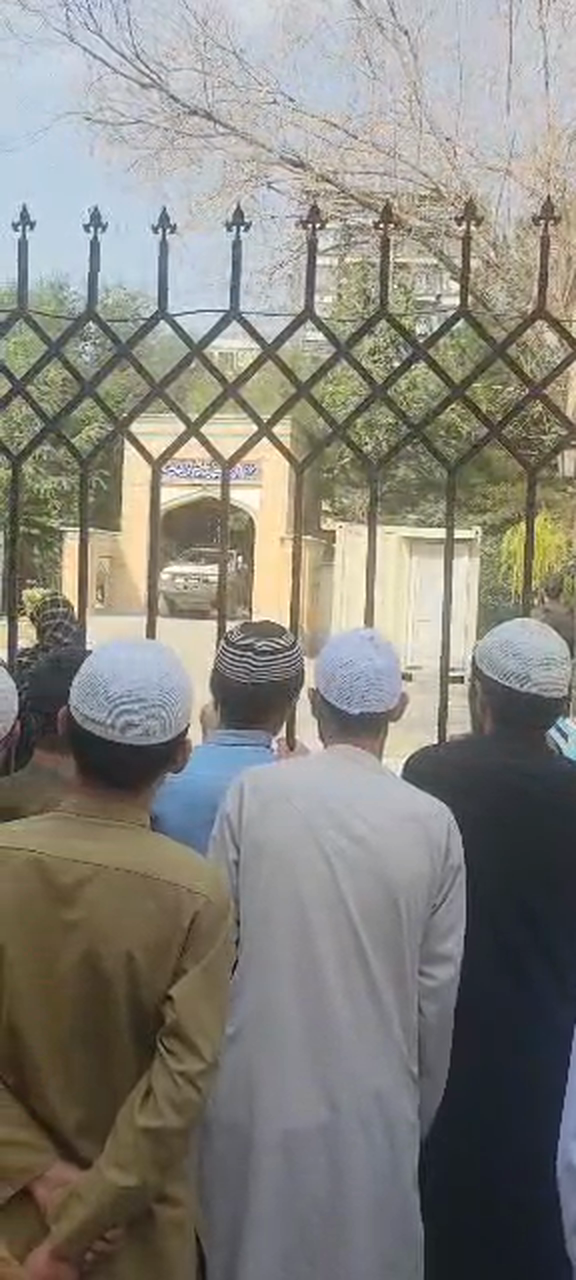
Figure 1: Seminary students confront armed Ministry of Justice units at the perimeter fence of Khatam al-Nabiyyin, Kabul, 5 September 2026. Geolocation: 34°29'23"N, 69°07'44"E (Darulaman Road). Video still verified via Shafaqna Afghanistan and Did Press.
“They didn’t arrive with land surveyors or court clerks,” recounts “Sayed Ali,” a 24-year-old advanced fiqh student from Daikundi whose identity is concealed to protect him from execution. “They came with zip-ties, iron truncheons, and loaded assault rifles. When our senior jurisprudence instructor produced notarized land deeds dating back to the monarchy, an officer with a Haqqani accent struck him across the collarbone with a rifle butt. He shouted: ‘You Rafidhi heretics have occupied Emirate land for thirty years. Your papers are worthless. Sign the Hanafi compliance form or get thrown on the truck.’”
By midnight, twenty-eight instructors, librarians, and students were dragged into unmarked pickups in the dark, according to local field reports verified by Afghanistan International and Did Press. Mohammad Jawad Mohseni, property director and head of the affiliated Tamadon Media Group, confirmed the mass detentions. As word traveled across Kabul’s Shia enclaves of Dasht-e Barchi and Karte Seh, hundreds of residents converged outside the compound's perimeter gates, chanting into the night air. Taliban commandos fired live bursts into the sky and deployed tear gas to break the gathering.
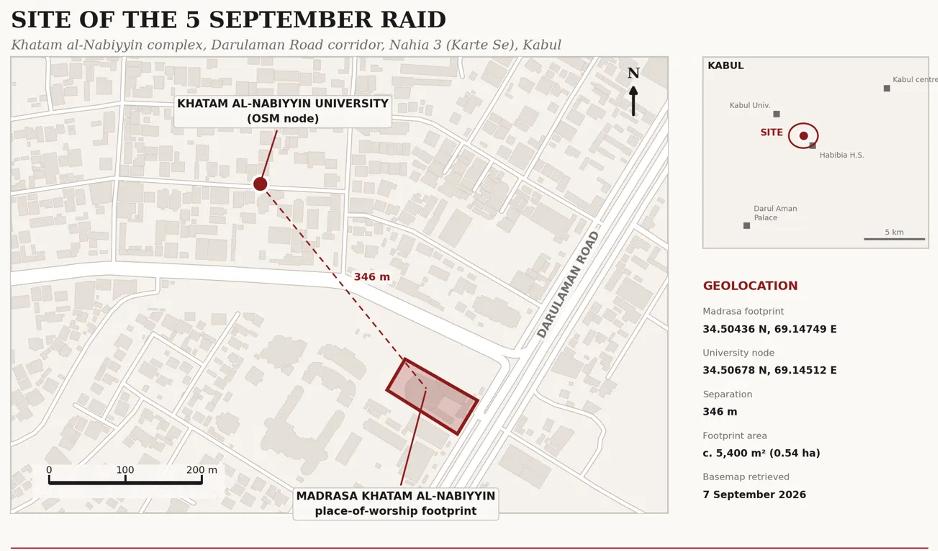 Figure 2: Site of the 5 September Raid: Al Khabeer geolocation of the Khatam al-Nabiyyin complex on the Darulaman Road corridor, Kabul.
The raid was not an impromptu zoning dispute; it was the culmination of a months-long operational plan. Founded in 2006 by Grand Ayatollah Mohammad Asif Mohseni, the compound stood as the intellectual Vatican of Afghan Shia Islam, containing an accredited university, a 50,000-volume theological library, and Tamadon TV. On 23 June, armed justice agents sealed Tamadon’s broadcast transmitters on charges of political affiliation a claim condemned by the Committee to Protect Journalists (CPJ). Two days later, the ministry chained the seminary’s library and classrooms, forcing hundreds of students to study on bare asphalt in 40°C heat.
Late last month, the Taliban deposed the university’s civilian administration, installing hardline Deobandi clerics. Then came the true objective: students and faculty were ordered to sign individual declarations professing allegiance to the Hanafi school of jurisprudence. The legal pretext that the compound occupies 'state property' was exposed when the ministry moved with troops before the Taliban’s own Special Land Dispute Court had even heard the appeal.
Khatam al-Nabiyyin exposes something much larger than a dispute over one seminary. Under the Taliban, the space for anyone outside their ideological mold is steadily disappearing. Women have been pushed out of education, employment and much of public life; girls have been shut out of classrooms; and now even Afghanistan’s Shia Muslims are being confronted with pressure over how they worship, what they teach and which religious school they are permitted to follow. The message is becoming brutally clear: Afghanistan under the Taliban is not being governed as a country of different communities, traditions and beliefs it is being forced into a single Taliban-approved identity. If you are a woman, your freedom is restricted. If you are a girl, your education can be taken away. If you are Shia, even your religious identity can come under pressure. The Taliban demand recognition abroad as the government of all Afghans while steadily narrowing who is permitted to live freely as an Afghan at home. Their diplomats speak of unity; their ministries enforce conformity. Women are told where they may go. Girls are told whether they may learn. Now Shia institutions are being told what religious identity they may publicly preserve.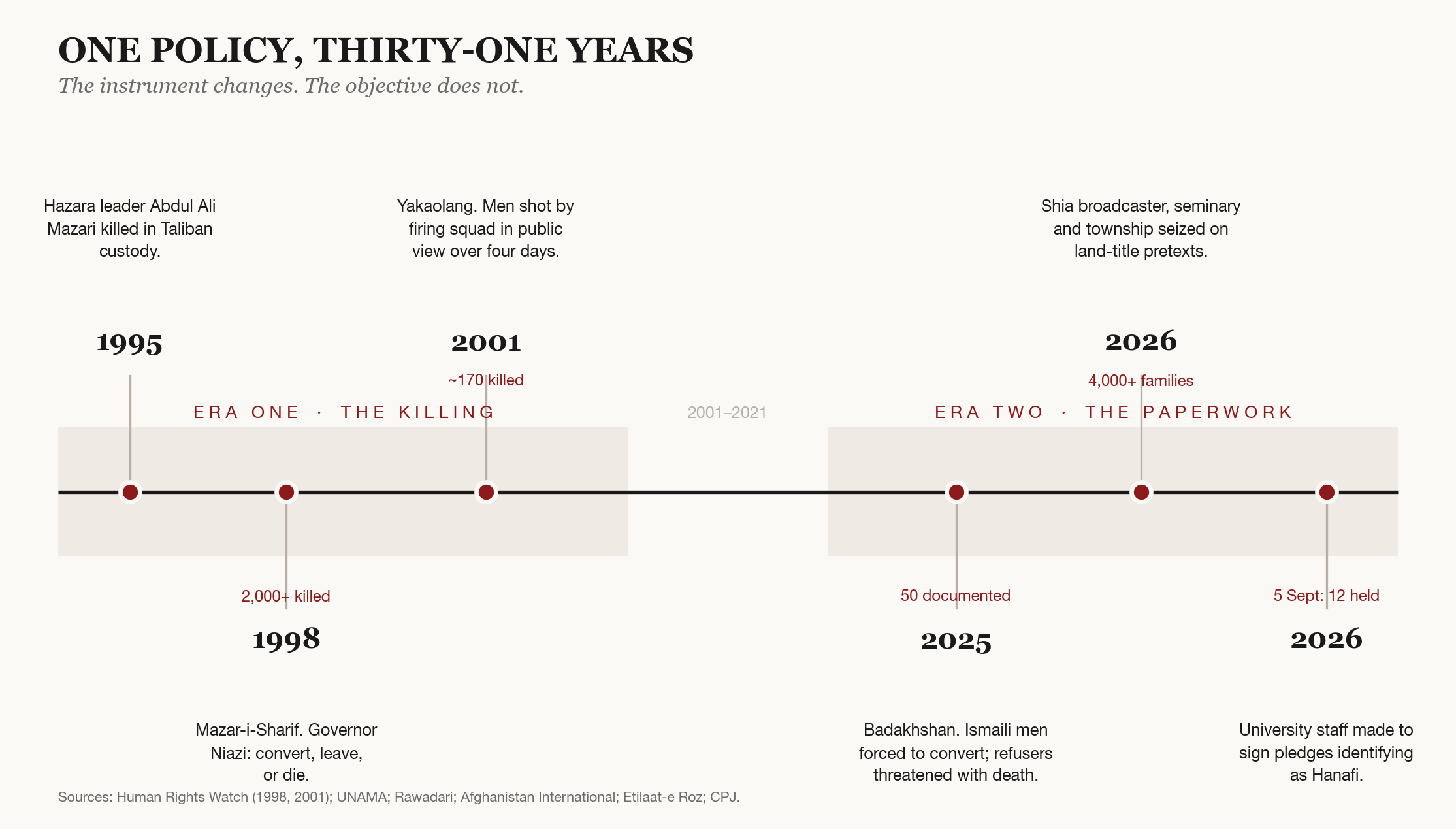
Figure 3: One Policy, Thirty-One Years: A timeline of Taliban actions against Afghanistan’s Shia communities, from the first Emirate to the present.
The timeline turns Khatam al-Nabiyyin from an isolated incident into part of a much longer question hanging over Taliban rule: how much has the movement itself changed, and how much has merely changed in the instruments through which its authority is imposed?
In August 1998, Taliban Governor Mullah Manon Niazi stood atop the pulpits of Mazar-i-Sharif and delivered an ultimatum to the city’s Shia: convert to Sunni Islam, leave Afghanistan, or die. Over two thousand civilians were slaughtered in seventy-two hours, as documented by Human Rights Watch. Twenty-eight years later, the ultimatum is identical. The Taliban of 2026 have simply replaced the machine gun with the Land Grab Commission under Justice Minister Mawlawi Abdul Hakim Sharayi. In 1998, the demand was shouted in blood. In 2026, it is executed through severed water pipes, rifle butts, and a mandatory checkbox on a ministry form.
The Taliban of 2026 have simply replaced the machine gun with the Land Grab Commission under Justice Minister Mawlawi Abdul Hakim Sharayi. In 1998, Taliban sectarianism wore combat boots. In 2026, it carries ministry letterhead. In 1998, the demand was shouted in blood. In 2026, it is executed through severed water pipes, rifle butts, and a mandatory checkbox on a ministry form.The instrument changed. The question of domination did not.
Follow Al Khabeer
Independent reporting on Afghanistan. Follow our work on social media for the latest news, fact checks and analysis.