Twenty-Five Years After 9/11, the Afghan Taliban Is Once Again a Warning the World Cannot Ignore
Twenty-five years after 9/11, Afghanistan under the Taliban is again providing space and protection to terrorist networks, raising a warning the world cannot afford to ignore.
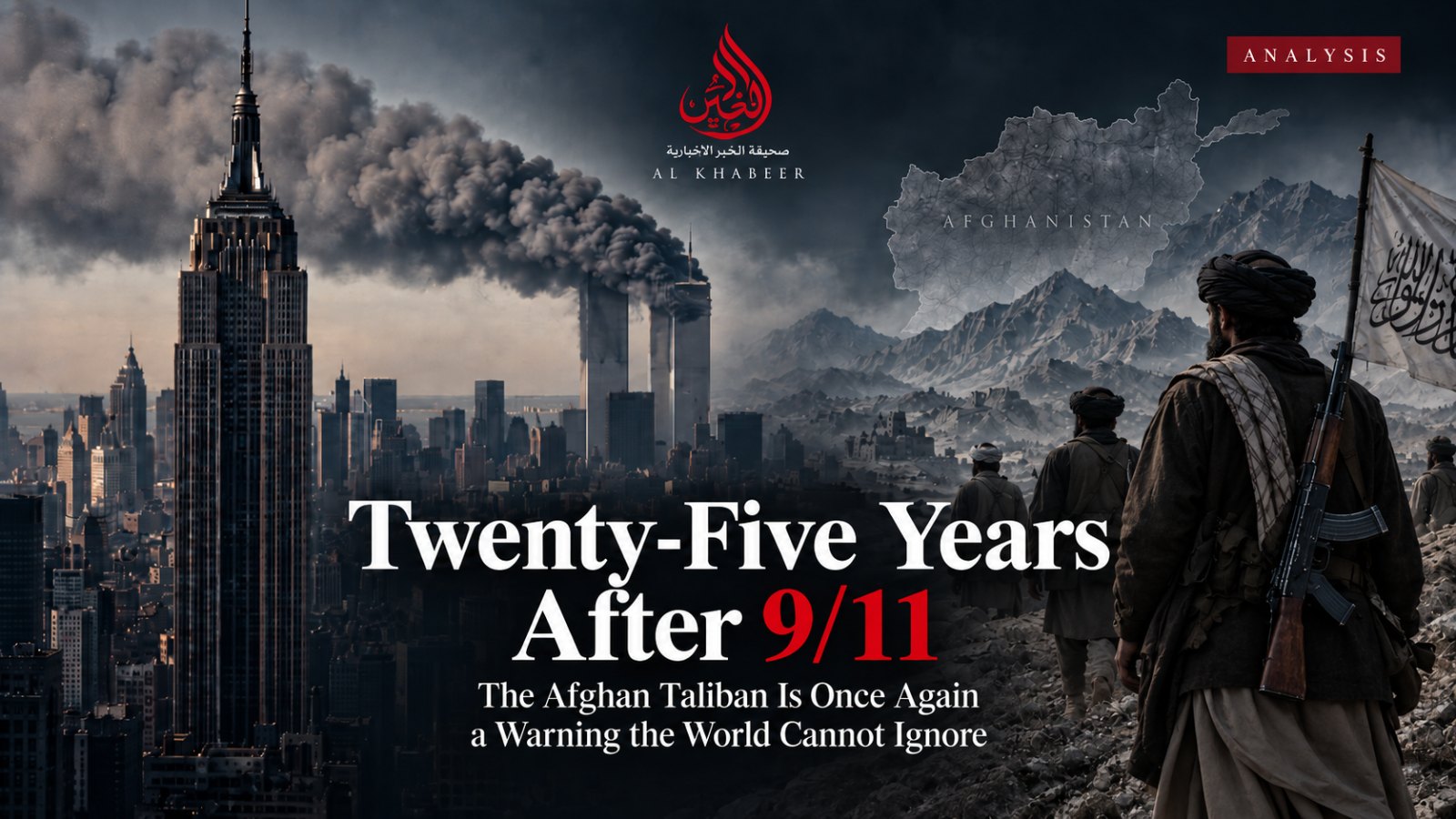
Twenty-five years after aircraft struck New York and Washington, the critical lesson was never about aircraft: it was about sanctuary.
Twenty-five years have passed since aircraft struck New York and Washington, but the most important lesson of September 11 was never about aircraft.
It was about sanctuary. The 9/11 Commission Report concluded that Osama bin Laden built an infrastructure in Afghanistan capable of recruiting, training and deploying terrorists against increasingly ambitious targets, while forging a close alliance with the Taliban regime that provided al-Qaeda sanctuary. The attacks demonstrated what can happen when a terrorist organization is given territory, protection, time and freedom to build networks beyond the world's immediate attention.
Today, the aircraft are gone. The Afghan Taliban are back and with them, Afghanistan become a sanctuary for terrorist groups once again.
The world should stop looking away. The Taliban must be held accountable for allowing militants to operate from Afghan soil.
9/11 Was Built in a Sanctuary: Not in a Single Morning
September 11 did not begin at 8:46 a.m. in New York. Its infrastructure had been developing for years in Afghanistan. Under the Taliban's first regime, al-Qaeda members enjoyed extraordinary freedom of movement. The 9/11 Commission documented how Afghanistan allowed the organization to train and indoctrinate recruits, import weapons, forge relationships with other jihadist organizations and prepare terrorist operations. The lesson should have been permanent: terrorist sanctuaries do not remain local problems.
Yet twenty-five years later, Afghanistan is once again controlled by the same Taliban movement, anchored in the very same theological covenant that Osama bin Laden forged with the regime, as documented in declassified CIA records (see Figure 1).
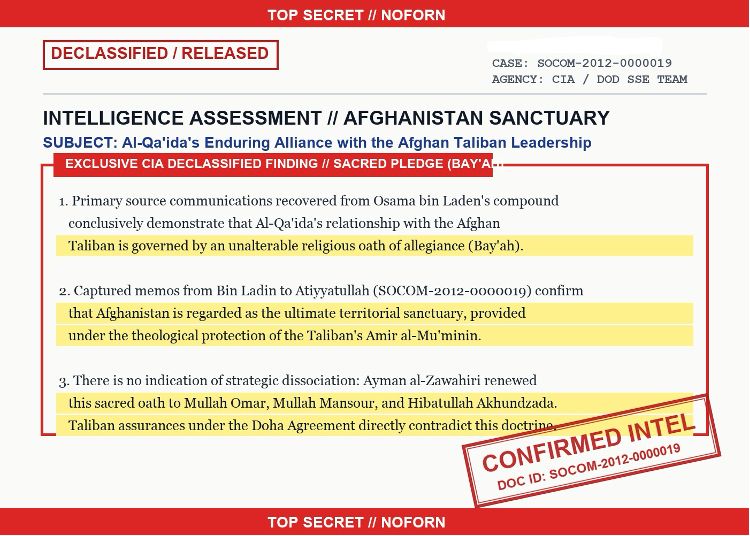
Figure 1: Declassified CIA Intelligence Archive: Document SOCOM-2012-0000019, confirming that Al-Qaeda's sanctuary in Afghanistan was established under an unalterable theological covenant (Bay'ah) to the Taliban's Amir al-Mu'minin, proving the sanctuary is doctrinal and enduring.
The Taliban Promised Peace. Zawahiri Was Found in Kabul
When the Afghan Taliban returned to power in August 2021, they repeatedly insisted that Afghan territory would not be allowed to threaten other countries.
Less than a year later, al-Qaeda leader Ayman al-Zawahiri was discovered in Kabul.
Following his killing in July 2022, the U.S. State Department said the Taliban had hosted and sheltered al-Qaeda's leader, describing his presence in Kabul as a violation of Taliban counterterrorism assurances.
Zawahiri was not hiding in an inaccessible mountain valley beyond Taliban authority.
He was living in the capital of Taliban-ruled Afghanistan, residing in an upscale villa in Kabul's Sherpur diplomatic district, as shown in the declassified CIA target model (Figure 2).
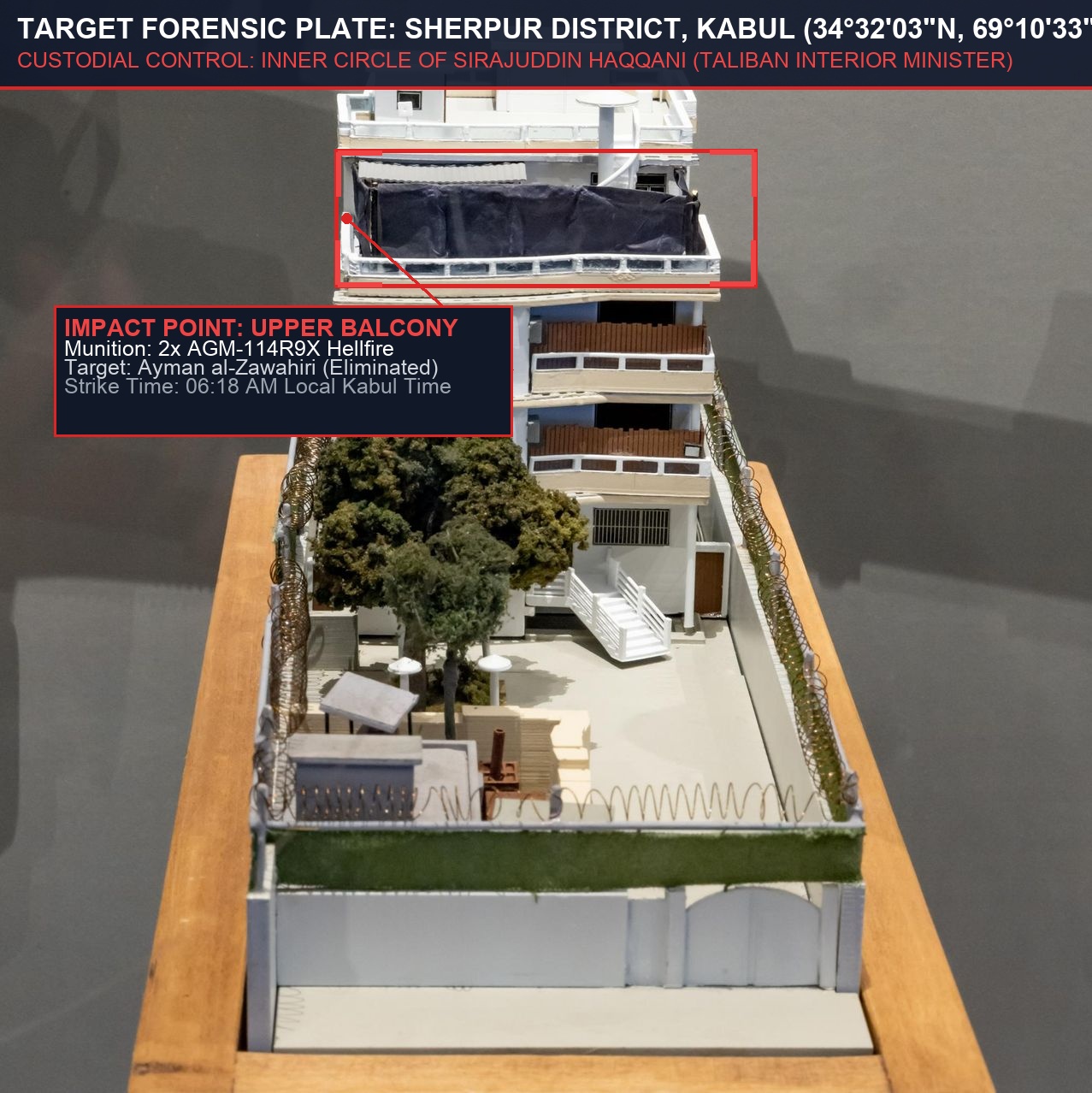
Figure 2: CIA Target Plate: Ayman al-Zawahiri's Safe House (Sherpur District, Kabul, 34°32'03"N, 69°10'33"E). Declassified architectural scale model engineered by the NGA model shop and displayed at the CIA Museum in Langley, Virginia. Red forensic markings identify the upper-floor balcony where Zawahiri was sheltered by the Taliban in downtown Kabul until two blade-equipped AGM-114R9X Hellfire missiles struck the balcony at 06:18 AM on July 31, 2022.
That single fact should have shattered the idea that diplomatic statements from Kabul were enough to prove that the old relationships had disappeared, particularly as United Nations assessments confirmed that senior Taliban leaders sheltered Zawahiri in Kabul with the direct knowledge of the regime's top leadership (see Figure 3).
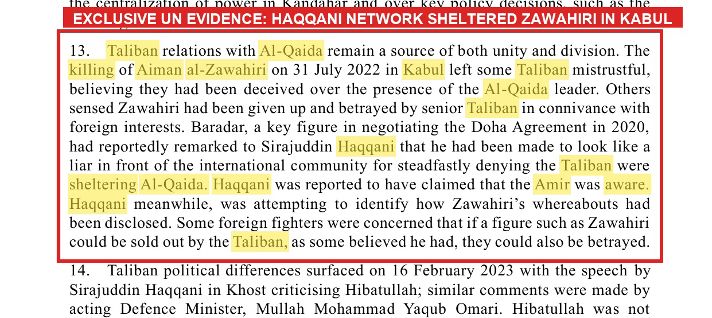
Figure 3: UN Security Council Report S/2023/370 (Page 7, Para 13), confirming that senior Taliban leaders sheltered Ayman al-Zawahiri in Kabul with the awareness of the Taliban Amir, and that Sirajuddin Haqqani launched an urgent investigation following the strike to uncover how the location of the safe house was disclosed.
But Zawahiri was not an isolated case. Other senior al-Qaeda figures have also been reported to remain in Afghanistan, while the Tehrik-e-Taliban Pakistan (TTP) leadership has continued to operate from Afghan territory. TTP chief Noor Wali Mehsud, along with senior commanders such as Mufti Muzahim, Qari Amjad, Omar Khalid Khorasani’s surviving network, and other senior TTP leaders, have benefited from the group’s presence across the border UN Security Council Report S/2023/370.
The same pattern extends to other militant organizations. Senior al-Qaeda figures, including Saif al-Adel, Yazid Mebrak, and other veteran commanders and facilitators, have remained part of the wider network connected to Afghanistan. Leaders and commanders linked to al-Qaeda in the Indian Subcontinent, Islamic State Khorasan, the East Turkestan Islamic Movement, and other armed groups have also operated in or around the country UN Security Council Report S/2024/72.
The names matter because these are not anonymous fighters hiding beyond the reach of the authorities. They are chiefs, deputies, planners, recruiters, financiers, and battlefield commanders whose organizations continue to threaten Afghanistan’s neighbors and the wider region.
The Taliban’s claim that Afghanistan is no longer a sanctuary therefore cannot be judged by official statements alone. It must be judged by whether senior terrorist leaders can live, organize, recruit, raise money, communicate, and direct attacks from Afghan soil.
Zawahiri’s presence in Kabul showed that they could. The continued presence of other al-Qaeda and TTP chiefs shows that the problem did not end with his death.
Fight One Terror Group, Shelter Another: That Is Not Counterterrorism
The Taliban point to their operations against ISKP as evidence that they are fighting terrorism. But fighting an organization that wants to overthrow the Taliban does not automatically make the Taliban a reliable counterterrorism partner.
Recent UN Monitoring Team assessments describe the continued presence of multiple terrorist organizations in Afghanistan and raise serious concerns over the Taliban's relationships with TTP, al-Qaeda and other foreign terrorist networks. This is not a picture of a country that has solved its terrorism problem.
It is a picture of a country where terrorist ecosystems continue to survive under Taliban rule, sustained by state-provided welfare payments and official identification documents, as shown in UN Security Council documentation (Figure 4).
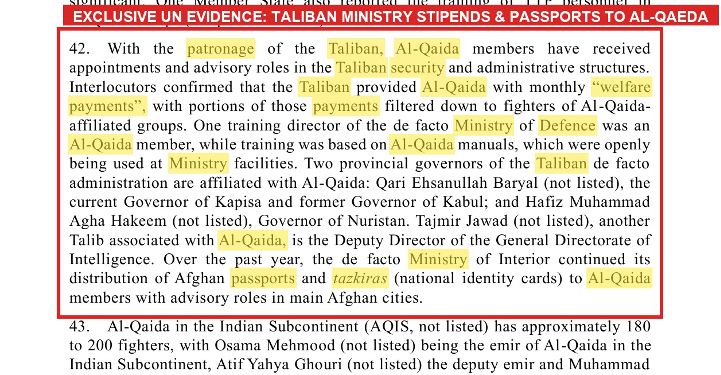
Figure 4: UN Security Council Report S/2023/370 (Page 14, Para 42), documenting that the Taliban Ministry of Defense provides regular monthly welfare stipends to Al-Qaeda operatives, while the Taliban's General Directorate of Intelligence (GDI) issues official Afghan passports and national identity cards (tazkiras) to foreign fighters.
For now, Pakistan is absorbing much of the immediate violence.
TTP attacks have intensified since the Taliban returned to Kabul, while international monitoring reports have repeatedly raised concerns regarding TTP's presence and operational freedom inside Afghanistan. But Pakistan being the first victim does not mean it will be the last.
That was precisely the mistake the world made before 9/11: assuming that terrorism incubating in Afghanistan was geographically distant until its consequences arrived thousands of kilometres away.
If the world ignores the threat now, Pakistan may be the first victim. But it will not necessarily be the last. The next target could be London, Paris, Moscow or another country that continues to look away while terrorist networks operate and expand. The danger does not remain confined to the region simply because the threat begins there.
The method can change. The Taliban’s sanctuary does not. Twenty-five years after 9/11, Afghanistan remains a warning: terrorists still find space, protection and opportunity under Taliban rule.
The danger is not hidden. The world is choosing to ignore it.
Follow Al Khabeer
Independent reporting on Afghanistan. Follow our work on social media for the latest news, fact checks and analysis.