From Terror to Trade Deals: How the Taliban Turn ISKP Attacks into Diplomatic Leverage
ISKP attacks struck foreign interests in Kabul. Trade deals followed. How the Taliban turned persistent insecurity into diplomatic leverage.
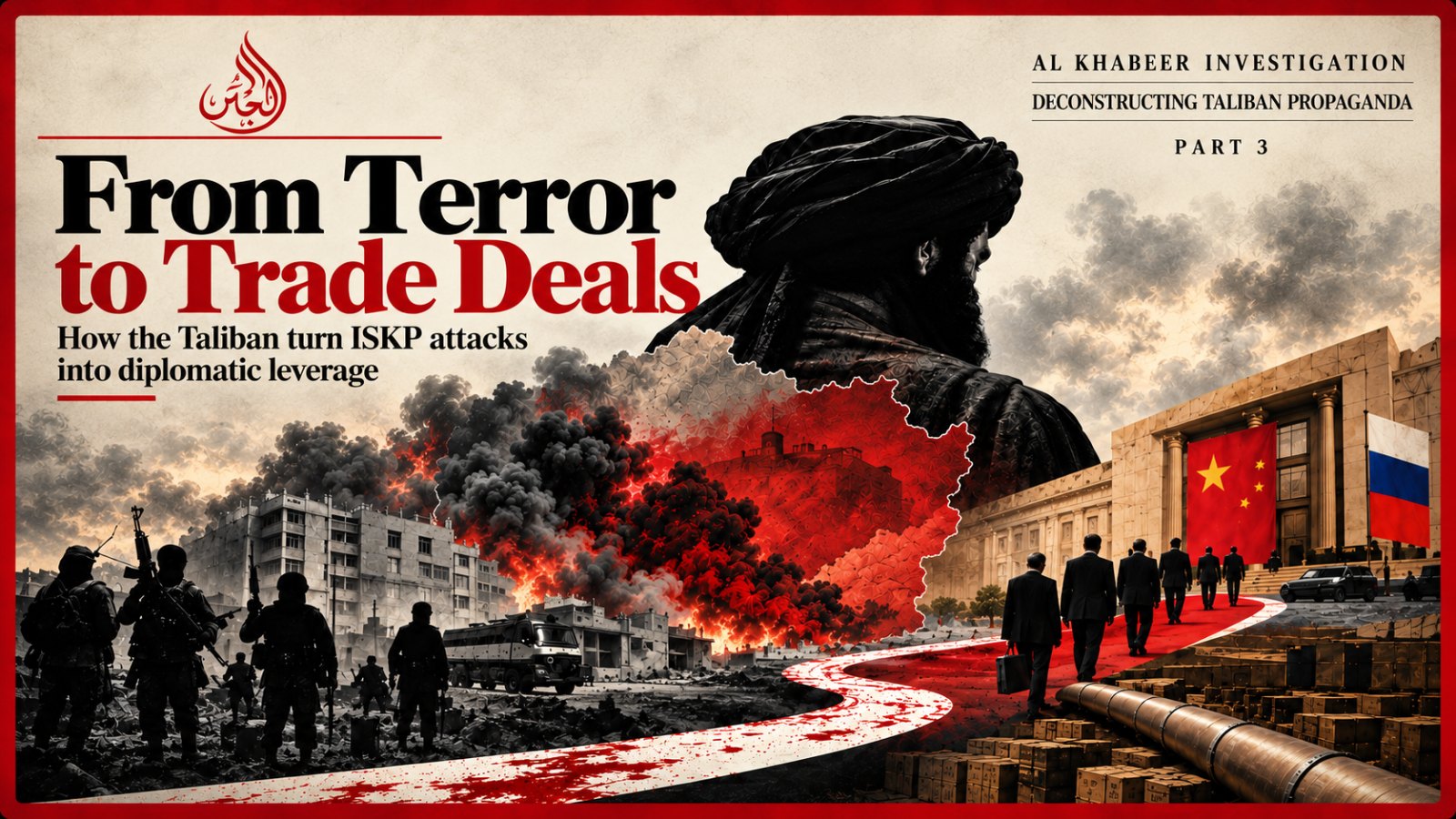
Foreign diplomats are attacked in Kabul. The Taliban fail to protect them. Yet the regime repeatedly emerges from these security disasters with new trade agreements, deeper diplomatic engagement, and a stronger claim to be the world's indispensable partner against terrorism. This is the central contradiction behind Kandahar's counterterrorism diplomacy. The Taliban want international governments to trust them as protectors against Islamic State Khorasan Province (ISKP), while their own security establishment is led by men with deep histories in Afghanistan's militant networks. Having allegedly exploited ISKP violence against northern resistance commanders in Badakhshan, the Taliban now face scrutiny over another disturbing pattern: terrorist attacks against foreign interests followed by diplomatic and economic gains for the regime. Kandahar has turned the terrorist threat it cannot eliminate into a powerful bargaining tool. Its security failures become arguments for cooperation, and its militant past is repackaged as counterterrorism expertise.
I. Blood in Kabul, Deals in Kandahar: The Taliban’s Terror-to-Trade Pattern
The disturbing pattern linking terrorist violence against foreign targets in Kabul to immediate diplomatic payoffs for the Taliban is unmistakable. Throughout late 2022, Beijing refused to commit state capital to Afghan mineral and petroleum extraction due to acute security concerns. On December 11, 2022, Chinese Ambassador Wang Yu met Taliban officials in Kabul, demanding urgent protection for Chinese nationals. Within twenty-four hours, heavily armed ISKP commandos breached the Kabul Longan Hotel in Shahr-e Naw, where Chinese investors and state engineers were staying (see Image 1). GDI commandos killed all three assailants, leaving no surviving attacker available for independent foreign interrogation. The Taliban subsequently positioned themselves as the essential authority through which Beijing would have to secure its personnel and investments in Afghanistan.
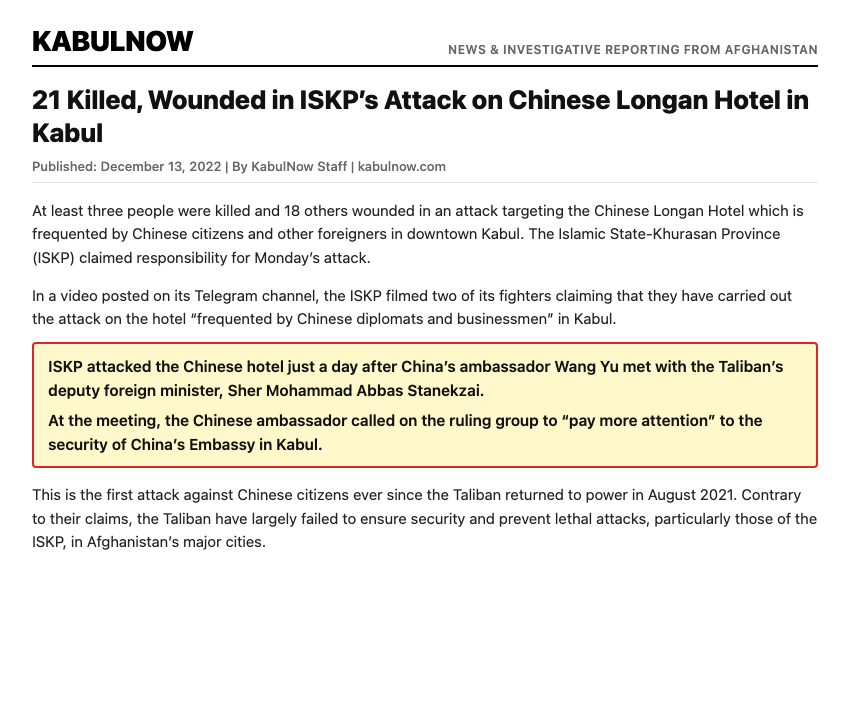
Source: kabulnow.com
The Taliban's reward came quickly. Exactly twenty-four days after the hotel attack, on January 5, 2023, the Taliban signed a historic twenty-five-year, $540 million contract with China's CAPEIC to extract crude oil from the northern Amu Darya basin (see Image 2). Within months, Beijing accredited an official ambassador to Kabul and accepted Taliban envoy Bilal Karimi at the Great Hall of the People, granting the internationally isolated Taliban regime its most significant diplomatic triumph. Beijing demanded protection. Within a day, Chinese nationals were targeted. Twenty-four days later, Kandahar secured a $540 million oil agreement. Terrorist violence exposed the Taliban's failure to protect foreign interests, yet the regime emerged with a major economic deal and growing diplomatic engagement. The Taliban's security failures did not prevent their diplomatic gains.
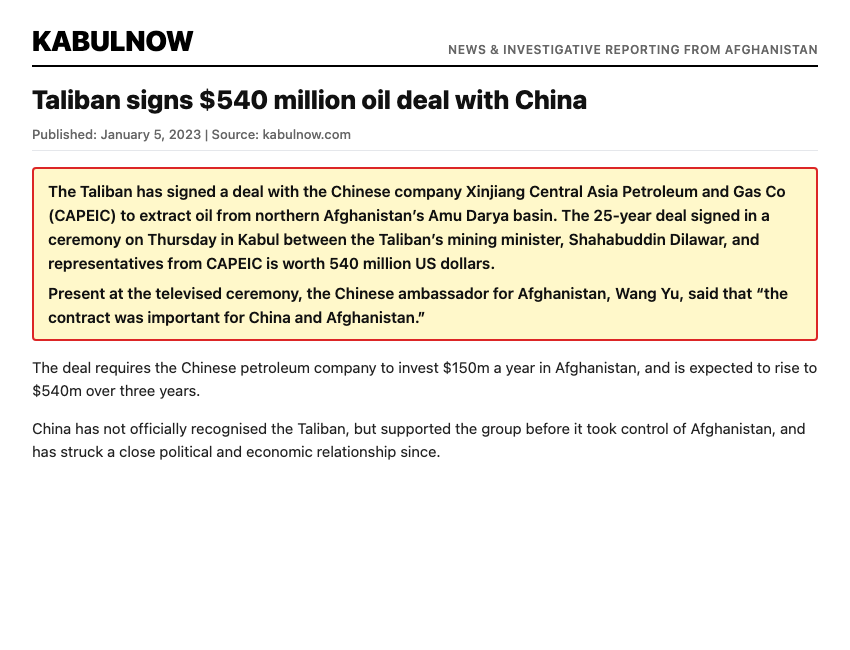
Source: kabulnow.com
Moscow experienced a similar contradiction. On September 5, 2022, an ISKP suicide operative detonated an explosive device at the consular gate of the Russian Embassy on Darulaman Road, killing two Russian diplomatic staff members. The attack exposed the Taliban's inability to protect even those foreign governments willing to maintain a diplomatic presence in Kabul. Exactly twenty-three days later, on September 28, 2022, the Taliban finalized their first major international trade agreement with Russia, securing discounted deliveries of gasoline, diesel, and wheat. Over 2023 and 2024, Russian Foreign Minister Sergey Lavrov and envoy Zamir Kabulov publicly branded the Taliban an “ally against terrorism,” culminating in Russia's Supreme Court moving to suspend the Taliban's terrorist designation (see Image 3). Two Russian diplomats were killed under Taliban rule. Moscow continued expanding its engagement with Kandahar. The regime that failed to protect Russia's embassy went on to strengthen its position as Russia's counterterrorism partner. Once again, the Taliban's promises of security carried political value despite a devastating security failure.
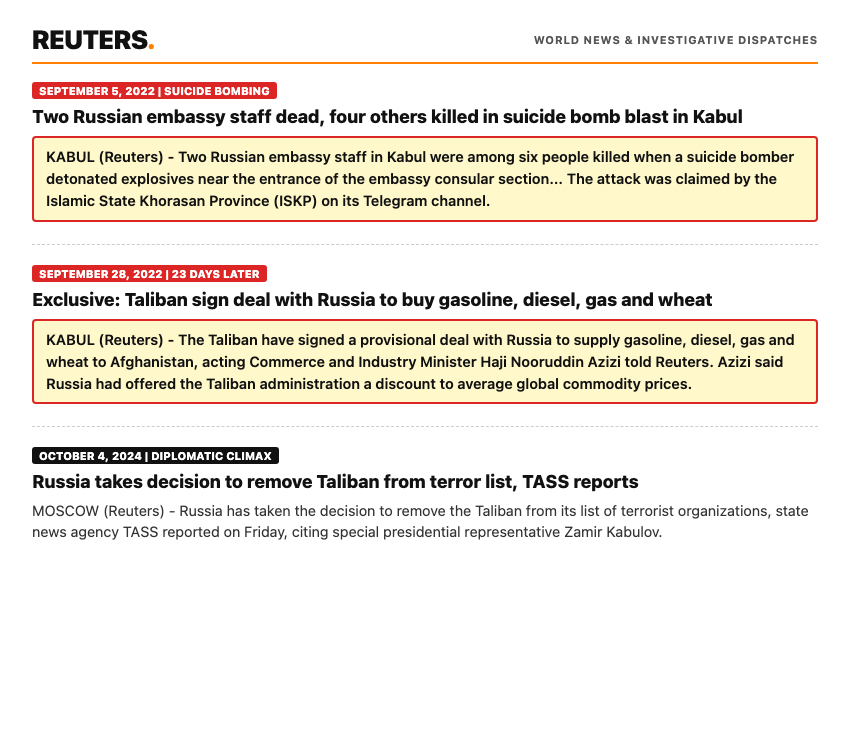 Source: reuters.com
II. Yesterday’s Suicide-Attack Commander, Today’s Security Guardian: The Taj Mir Jawad Hypocrisy
The Taliban's most glaring hypocrisy in counterterrorism diplomacy centers on the official directing it: Mullah Taj Mir Jawad, First Deputy Director General of the GDI. Throughout the twenty-year Republic, Jawad directed the Haqqani Network's infamous Kabul Attack Network and commanded the Al-Hamza Martyrdom Brigade, the specialized suicide division responsible for orchestrating the deadliest urban assaults against foreign embassies, international hotels, and government ministries in Kabul. Documentation from West Point's Combating Terrorism Center and official statutory records from the Australian Government identify reported connections between ISKP supreme leader Sanaullah Ghafari (Shahab al-Muhajir) and the Haqqani militant network. The Taliban's intelligence establishment cannot escape scrutiny of these overlapping militant histories simply by declaring itself an enemy of ISKP.
Today, foreign envoys from Russia, China, and regional capitals sit opposite Taj Mir Jawad to solicit security guarantees against suicide bombers. The very commander associated with Kabul's former suicide-warfare machinery now markets security against the type of violence that defined his own militant past. The Taliban want foreign governments to trust an intelligence establishment led by figures from networks that once threatened the very diplomatic missions they now promise to protect. A new title cannot erase that history. The old militant commanders have entered government offices, but their past remains central to judging the credibility of Taliban security assurances.
Jawad's public rhetoric exposes the hollowness of the regime's attempt to distance itself from its militant origins. In a televised broadcast on Taliban state television, preserved by Amu TV (see Image 4), Jawad delivered a blunt admission: “We strapped explosives to ourselves to bring this system to power, and to defend it we will again strap explosives to ourselves and detonate.” The statement captures the contradiction at the heart of Taliban counterterrorism diplomacy. The regime asks the world to recognize its intelligence officials as guardians of security while those same officials openly celebrate the militant methods that brought them to power. The GDI's new institutional identity cannot erase the old militant machinery from which its leadership emerged.
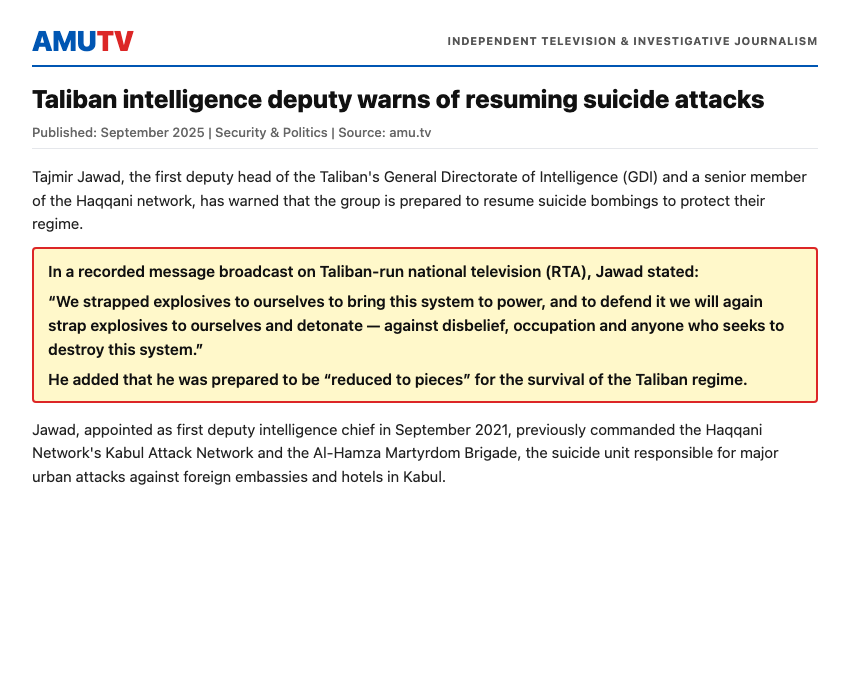 Source: amu.tv
III. The Taliban’s Protection Racket: Using the ISKP Threat to Secure Political Survival
Following the January 2024 Kerman bombings in Iran and the March 2024 Crocus City Hall massacre in Moscow, both attributed to ISKP, the Taliban foreign ministry and GDI-linked media outlet Al-Mirsad launched a campaign defending the regime's counterterrorism record. Taliban officials denied the continued existence of terrorist training infrastructure on Afghan territory and directed accusations toward Pakistan and Tajikistan. Yet international reporting continued to challenge the Taliban's assurances. United Nations Security Council reporting contradicted the Taliban's previous claim that Sanaullah Ghafari had been killed in June 2023 and raised further concerns about ISKP's presence and movements within Afghanistan, including Kunar and Badakhshan (see Image 5). The Taliban proclaim that Afghanistan is secure while terrorist networks continue to threaten regional capitals. Their declarations of success cannot conceal the continuing security crisis under their rule.
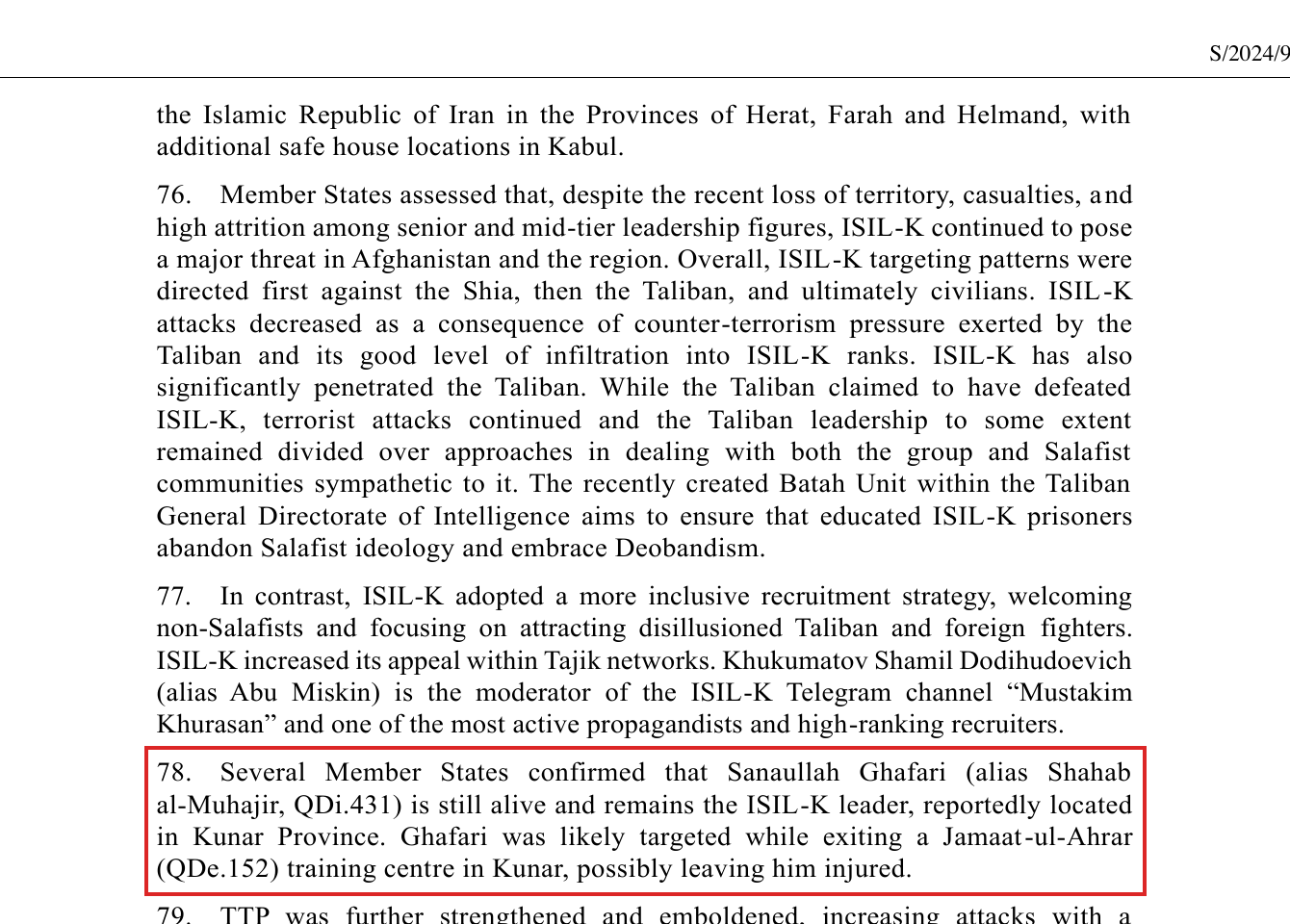
Source: United Nations Security Council S/2024/92
The Taliban's diplomatic message rests on a convenient contradiction. They claim to have restored security inside Afghanistan while warning foreign governments that terrorism will spread if Kandahar is isolated. Their security failures become arguments for closer cooperation, and the ISKP threat they have failed to eliminate becomes a reason for other countries to strengthen relations with them. The Taliban demand political recognition for fighting terrorism while using the continuing terrorist threat to justify their own diplomatic importance.
Simultaneously, Foreign Minister Amir Khan Muttaqi and chief spokesman Zabihullah Mujahid have promoted counterterrorism cooperation with Tehran and Moscow as a central justification for engaging with the regime. At international meetings, Taliban representatives seek diplomatic recognition, access to frozen financial resources, and continued international engagement while warning of the consequences of Afghanistan's isolation. Their message is unmistakable: foreign governments are expected to support Kandahar because instability in Afghanistan threatens the entire region. The regime has made the fear of ISKP central to its argument for political survival.
The Chinese hotel attack was followed by a major oil agreement. The Russian Embassy attack was followed by expanded trade and deeper engagement. Former commanders from Afghanistan's militant networks now occupy senior positions in the intelligence establishment that promises protection to foreign governments. These facts expose a fundamental contradiction in Taliban diplomacy: the regime repeatedly benefits from international cooperation intended to address insecurity that persists under its own rule.
The Taliban want the world to judge them by the terrorist threat they promise to contain, not by the militant networks their leaders helped build or the security failures that continue under their government. They demand trust without resolving the contradictions in their own security establishment. They seek recognition while invoking the dangers of international isolation. And they present themselves as indispensable protectors against a threat they have repeatedly failed to defeat.
Kandahar's counterterrorism diplomacy has turned insecurity into political leverage. The Taliban failed to protect foreign diplomats, yet strengthened ties with foreign governments. Their former militant commanders now sell security assurances to the international community. The regime's most valuable diplomatic argument is no longer the peace it has delivered, but the danger it warns will follow if the world refuses to cooperate with it.
Follow Al Khabeer
Independent reporting on Afghanistan. Follow our work on social media for the latest news, fact checks and analysis.