In Issue 1 of this investigative series, Al-Khabeer exposed TTP's foundational theological crime: inventing the novel category of 'Mubah al-Dam' (admitting Pakistani soldiers possess sound Islamic faith yet declaring their murder lawful) and Amir Noor Wali Mehsud's written confessions in Inqilab-e-Mehsud of slaughtering peace committee delegates and bombing a civilian sports gathering of the Marwat tribe.
Now, in Issue 2, we examine TTP's primary recruitment manifesto, Ta'aruf Tehreek Taliban Pakistan (authored by central shura member Mufti Ghufran), alongside Noor Wali's 689-page chronicle Inqilab-e-Mehsud. When confronted with cold historical facts and authentic Islamic law, TTP's scholarly facade collapses into four undeniable deceptions.
The Dead Cannot Sign a Fatwa
On page 3 of Ta'aruf Tehreek Taliban Pakistan, under the bold headline «تحریک طالبان پاکستان کا جہاد، دفاعی جہاد ہے!» ("TTP's Jihad is Defensive Jihad!"), the leadership asserts that its twenty-year war of terror is a defensive religious obligation (Difa'i Jihad) sanctioned by a 2004 collective fatwa of 500 scholars regarding the military operation in Wana. TTP prominently parades the names of Mufti Nizam al-Din Shamzai, Sheikh Dr. Sher Ali Shah, and Maulana Abdur Razzaq Iskander to manufacture the illusion of religious consensus.
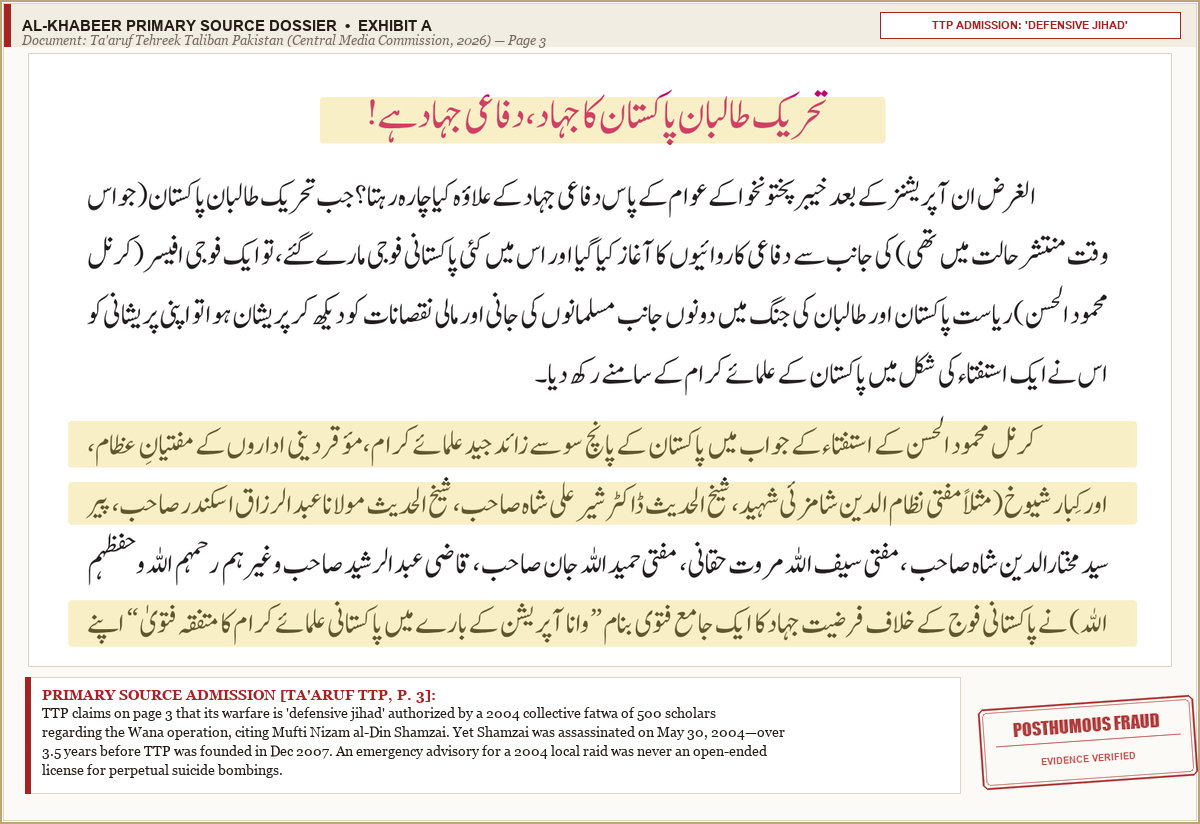
Mufti Shamzai was already resting in his grave for more than forty months before Baitullah Mehsud ever established the TTP. How can a martyred scholar authorize an organization that did not exist during his lifetime?
Furthermore, the 2004 scholar statement was an emergency advisory regarding a specific, localized military operation in Wana, pleading to halt intra-Muslim bloodletting. By what demonic theological gymnastics does a 2004 local appeal for peace become a twenty-year religious mandate for suicide bombings against Pakistani mosques, police stations, and civilian markets? Living signatories—such as Maulana Abdur Razzaq Iskander (longtime head of Wifaq ul Madaris)—subsequently signed unanimous national fatwas explicitly declaring attacks on state forces categorically Haram. TTP digs up dead scholars to sanctify bloodshed they never authorized.
Robbing the Scholar Who Branded Them Rebels
In Ta'aruf TTP, pages 10 through 14, TTP quotes five consecutive pages from Sheikh al-Islam Mufti Muhammad Taqi Usmani's book, Nafaz-e-Shariat aur Uske Masail (The Implementation of Shariah and Its Challenges).
On page 14, TTP seizes upon his academic observation that piecemeal "patchwork" (پیوند کاری) on legacy colonial laws cannot achieve complete Islamic legislation. Immediately beneath this quote, TTP’s author makes a shameless leap: «کیا تحریک طالبان پاکستان کا ریاست پاکستان کے خلاف اسلحہ اٹھانا بغاوت اور خروج ہے؟» ("Is TTP taking up arms against the state of Pakistan rebellion and Khuruj? ... No, it is jihad!").
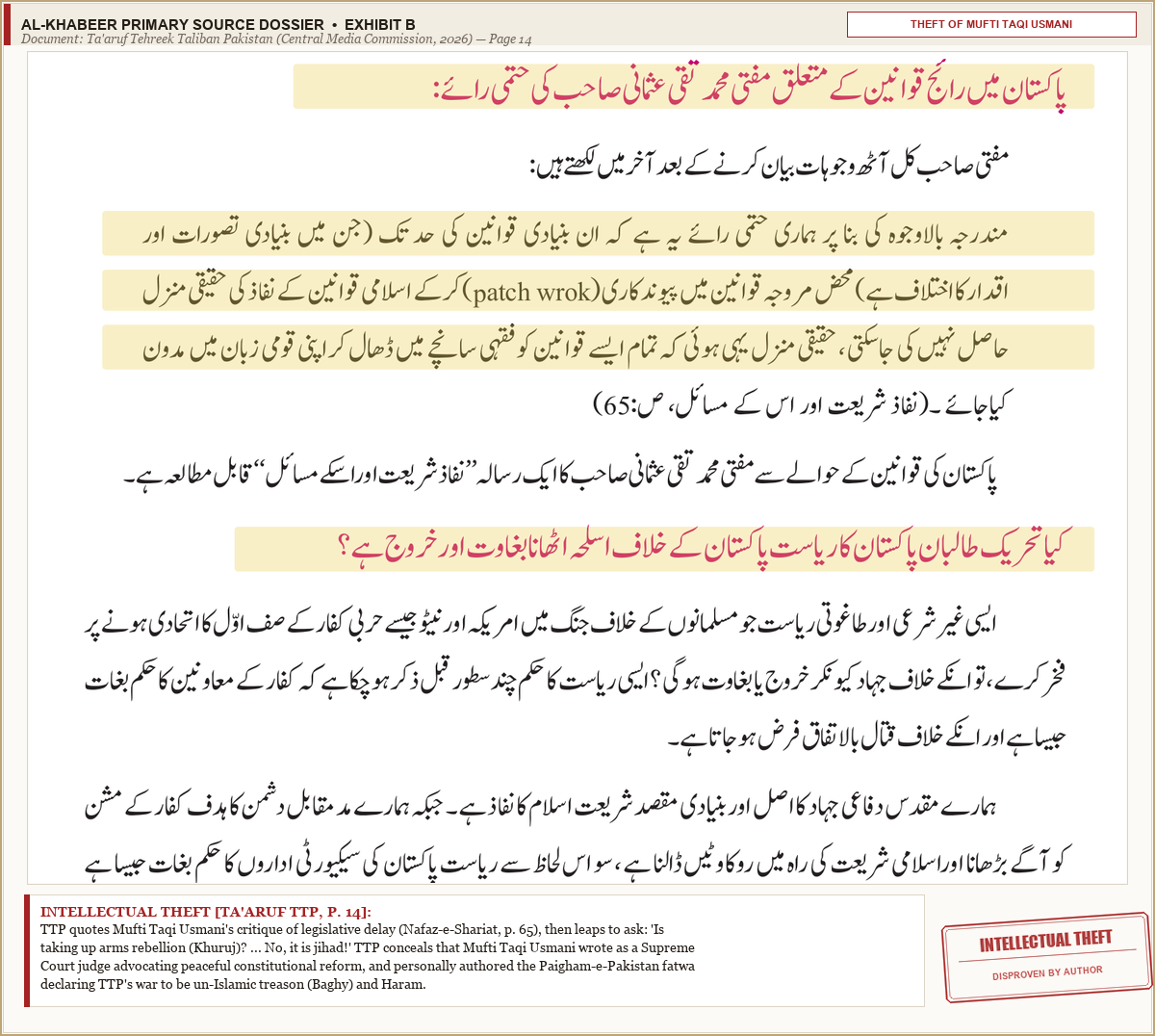
This is outright intellectual identity theft. Mufti Taqi Usmani is not a rebel ideologue. He served as a senior judge on the Shariat Appellate Bench of the Supreme Court of Pakistan, dedicating his entire career to constitutional and legislative reform from within.
More fatally for TTP, Mufti Taqi Usmani personally drafted and led the historic Paigham-e-Pakistan national consensus fatwa—signed by 1,829 Islamic scholars across all denominations. That fatwa decreed in absolute terms that waging armed warfare against the Pakistani armed forces and security personnel is not Jihad; it is outright Baghy (rebellion) and strictly forbidden (Haram Mutlaq).
When TTP negotiators met Pakistani scholars in Kabul in 2022, Mufti Taqi Usmani looked them in the eye and told them directly: "Lay down your arms." TTP quotes a paragraph of his legal theory from thirty years ago, while burying the author's living religious verdict that brands them as criminal rebels.
Twisting the Imams: Turning Hanafi Fiqh Upside Down
TTP wraps itself in the Hanafi cloak to deceive the tribal public, yet tramples every foundational principle of Imam Abu Hanifa.
On pages 5–7 of Ta'aruf TTP, the group attempts to construct a classical Hanafi justification for slaughtering Pakistani soldiers. They cite Imam al-Sarakhsi's Sharh al-Siyar al-Kabir and Imam al-Ayni's Al-Binayah, which discuss Muslims who physically join an invading pagan army (man'at al-mushrikeen) attacking Muslim territories. From these texts, TTP deduces that all Pakistani soldiers are "Harbi Kuffar" whose blood is lawful to spill (Mubah al-Dam) and for whom funeral prayers (Janazah) are forbidden.
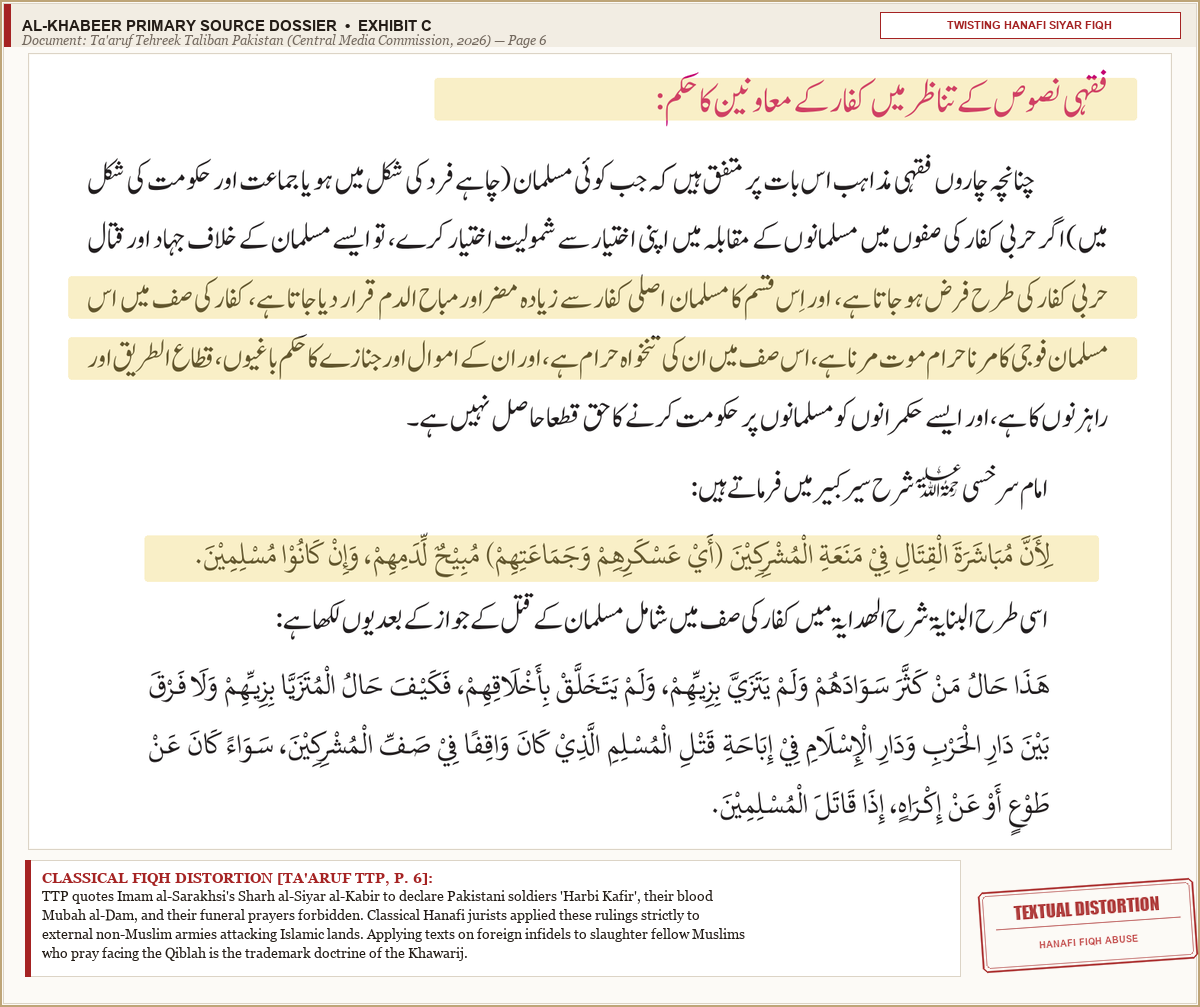
This is a catastrophic theological distortion. Classical Hanafi jurists formulated these chapters exclusively for foreign, external non-Muslim invasions (such as pagan Mongol or Crusader hordes). Imam al-A'zam Abu Hanifa himself laid down the unbreakable creed of Sunni Islam in Al-Fiqh al-Akbar:
"We do not declare anyone from the people of the Qiblah an unbeliever due to a sin, nor do we strip him of faith, nor do we make lawful the blood of a Muslim."
In Al-Fiqh al-Absat, Abu Hanifa categorically forbade taking up arms (Khuruj) against Muslim rulers, even if unjust, to prevent the catastrophic ruin of society. Taking legal rulings formulated for pagan invaders attacking the frontiers of Islam, and weaponizing them to slaughter Muslims who pray facing the Kaaba five times a day, is the historic, bloodstained hallmark of the Khawarij.
Noor Wali's Own Account: A Bodyguard’s Bullet and a Broken Trust
While Ta'aruf TTP manufactures an academic disguise, current TTP Amir Noor Wali Mehsud’s own 689-page book, Inqilab-e-Mehsud (p. 186), reveals the organization's true operational identity: gangland treachery and the cowardice of cold-blooded betrayal.
In 2009, prominent tribal leader Qari Zain al-Din broke away from Baitullah Mehsud, publicly denouncing TTP's suicide bombings against innocent Muslims as un-Islamic. In his book, Noor Wali confesses in black and white how TTP responded: Baitullah ordered an operative named Gul Badin to infiltrate Zain al-Din's compound, swear false loyalty, and become his trusted personal bodyguard. On June 23, 2009, this bodyguard entered Zain al-Din's bedroom and shot him dead while he lay defenseless.
Noor Wali boasts: "Due to this operation, the mujahedeen viewed Gul Badin with deep honor."
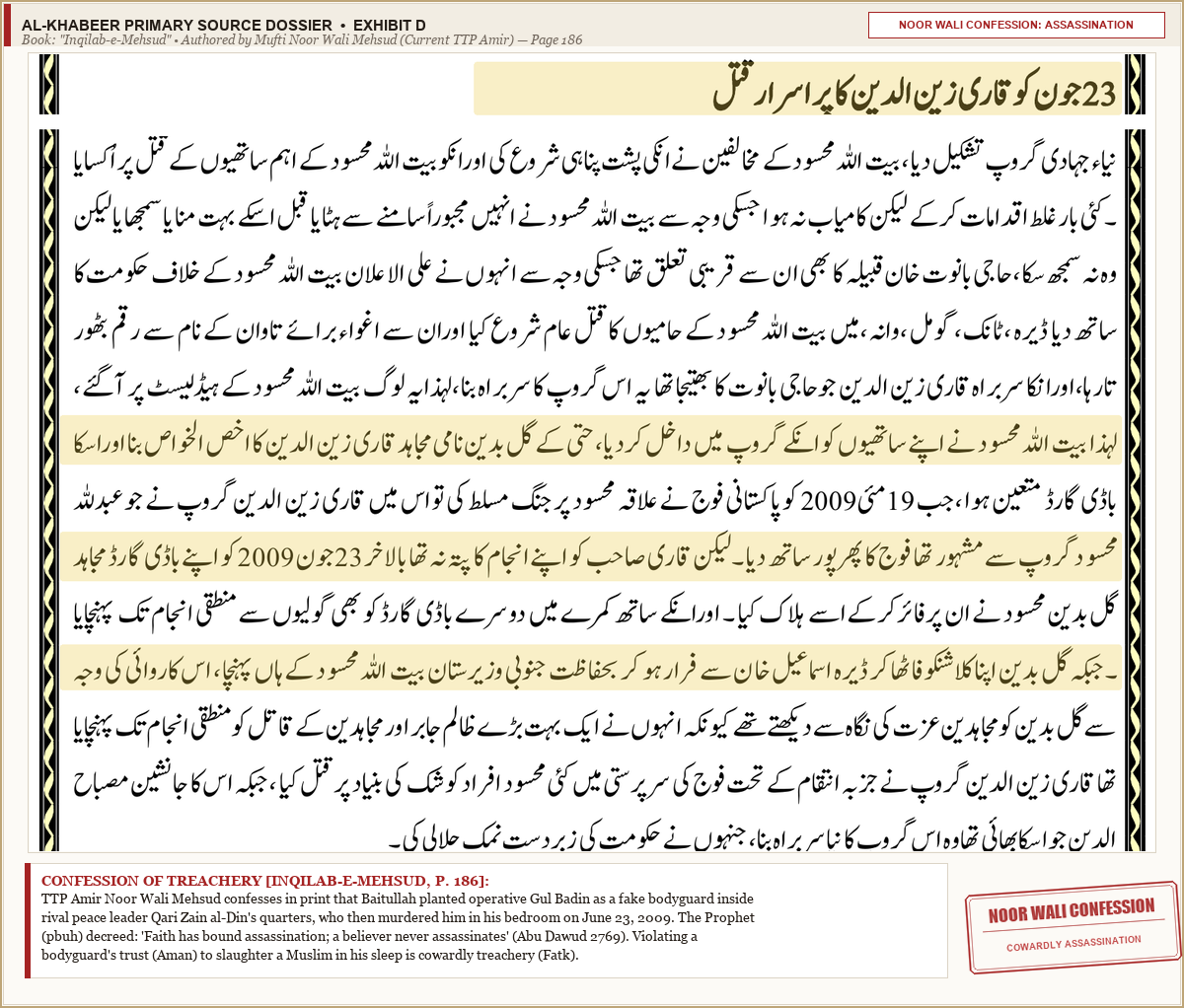
In Islamic Shariah and Pashtun honor, a bodyguard’s duty is a sacred covenant of trust (Aman). The Prophet ﷺ decreed: "Faith has bound assassination; a believer never commits assassination" (Sunan Abi Dawud 2769).
Violating a solemn oath of protection to murder a defenseless man in his bedroom is not jihad. It is not even tribal chivalry. It is cowardly treachery (Fatk) and blatant hypocrisy (Nifaq). Celebrating this criminal betrayal in print strips TTP of any shred of Islamic or Pashtun dignity.
Islamic Law vs. TTP Ideology
| Domain | Authentic Hanafi / Sunni Jurisprudence | Documented TTP Doctrine & Practice |
|---|---|---|
| Armed Revolt (Khuruj) | Categorically forbidden (Haram) by Imam Abu Hanifa, Imam Tahawi, and Sunni consensus to prevent chaos (Fitnah). | Celebrated as highest religious duty; disguised as 'defensive jihad' using obsolete, localized fatwas. |
| Sanctity of Blood | Absolute inviolability. A Muslim who sins or serves in state security remains a believer with sacred blood. | Invented 'Mubah al-Dam': soldiers admitted to have sound faith are declared lawful to slaughter. |
| Scholarly Authority | Adhering to living consensus (Ijma) and institutional reform (Mufti Taqi Usmani's Paigham-e-Pakistan). | Intellectual theft: exploiting dead scholars out of context and misquoting living jurists who condemn them. |
| Assassination & Trust | Strictly prohibited. The Prophet ﷺ decreed that faith shackles assassination (Fatk) and forbids treachery (Ghadr). | Infiltrating fake bodyguards to execute sleeping rivals in bedrooms (Noor Wali's confession in Inqilab-e-Mehsud). |
The Verdict: A Manufactured Jihad Exposed
Every exhibit in this investigation is drawn directly from TTP’s own literature: Ta'aruf TTP by Mufti Ghufran and Inqilab-e-Mehsud by Noor Wali Mehsud. The evidence exposes a syndicate of deception that collapses on every front:
- They claim Mufti Shamzai—yet Shamzai was in his grave three and a half years before TTP was founded.
- They quote Mufti Taqi Usmani—yet Usmani declared their war un-Islamic rebellion (Baghy) and commanded them to lay down their arms.
- They claim the Hanafi school—yet Imam Abu Hanifa cursed the shedding of Muslim blood and strictly outlawed Khuruj.
- They boast of tribal honor—yet their own Amir brags of planting fake bodyguards to shoot sleeping men in their bedrooms.
To the fathers, the sons, and the youth of Waziristan, Kurram, Bajaur, and Khyber Pakhtunkhwa: Do not sell your souls for a manufactured war. The Prophet ﷺ warned: "Whoever bears arms against us is not from us, and whoever deceives us is not from us" (Sahih al-Bukhari 6874). TTP has drawn weapons against the believers and deceived them through false oaths.
When an organization must dig up dead scholars to justify killing living believers, its cause is already dead. Read their books with your own eyes. The mask has fallen.